
The short answer
No, but fewer young developers are being hired. The data shows the squeeze coming through hiring, not layoffs, and junior work is changing shape rather than disappearing.
The clearest number comes from Stanford. Using ADP payroll data through June 2026, Brynjolfsson, Chandar and Chen find that US workers aged 22 to 25 in AI-exposed occupations are 19% below where they would be had they kept pace with less-exposed peers.
At the same time, the US government still projects growth for software developers, and GitHub counts more developers than ever. The rest of this post goes through each source, with its date, and what it means if you hire.
What the payroll data shows (Stanford, ADP)
The gap sits with young workers in jobs where AI does the task instead of helping with it. Stanford’s “Canaries in the Coal Mine?” paper, revised on 12 August 2026, tracks millions of US workers through ADP payroll records.
Its main finding is the 19% gap for 22 to 25 year olds in AI-exposed occupations. Experienced workers in the same occupations show no comparable gap.
In plain levels, the August 2026 paper says employment of 22 to 25 year olds in the two most exposed groups fell about 11% between November 2022 and June 2026. In the three least exposed groups, the same age band grew about 10%.
The gap has widened. On the paper’s current descriptive measure, the shortfall was 15% at the July 2025 data vintage and 19% as of June 2026.
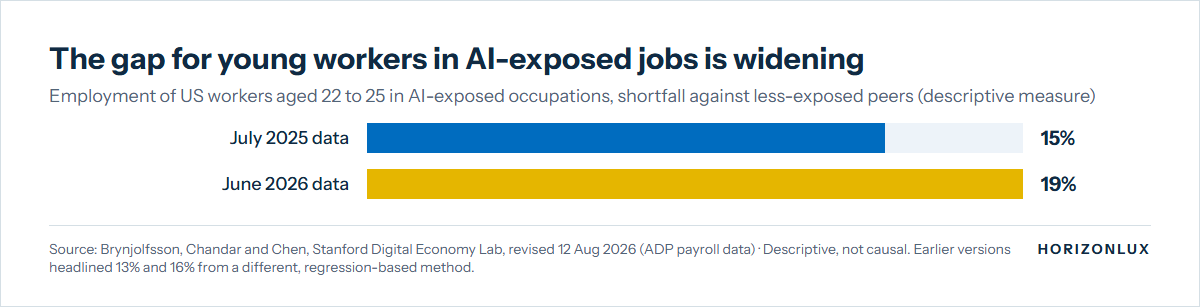 Source: Brynjolfsson, Chandar and Chen, Stanford Digital Economy Lab, revised 12 Aug 2026. Chart by HorizonLux.
You may have seen 13% or 16% quoted. Those were the headline figures in earlier versions, and they came from a different method: regression estimates adjusting for firm-level shocks, at 13% on July 2025 data and 16% on September 2025 data. The authors now lead with the simpler descriptive measure, so do not line the three numbers up as one series.
Three details matter for anyone reading this as a jobs forecast:
- It is hiring, not firing. The authors say the divergence works mainly through reduced hiring of young workers, not more separations.
- Augmentation is different. Where AI mainly complements workers, employment is “flat or rising”, especially for experienced staff.
- It is not causal. The authors call their results early, descriptive indicators, not causal estimates, and they find no evidence of widespread, economy-wide job displacement.
The paper names software development among the most exposed occupations, but its text gives no separate headline figure for software developers. We have not quoted one.
What the government projects (BLS)
The US Bureau of Labor Statistics still projects growth for software developers. It projects a decline for “computer programmers”, the occupation closest to routine coding.
Both figures come from the BLS Occupational Outlook Handbook, last modified 27 August 2026, with projections for 2025 to 2035:
- Software developers: 1,717,800 jobs in 2025, projected to grow 10%. Median pay was $135,980 in May 2025.
- Software QA analysts and testers: projected to grow 6%. BLS expects about 106,100 openings a year across developers, QA analysts and testers combined.
- Computer programmers: 110,800 jobs in 2025, projected to fall 7%, or about 8,100 jobs. Median pay was $100,390 in May 2025.
BLS gives its reason directly: “Computer programming work continues to be automated.” It adds that some programming tasks will shift to other workers, such as software developers.
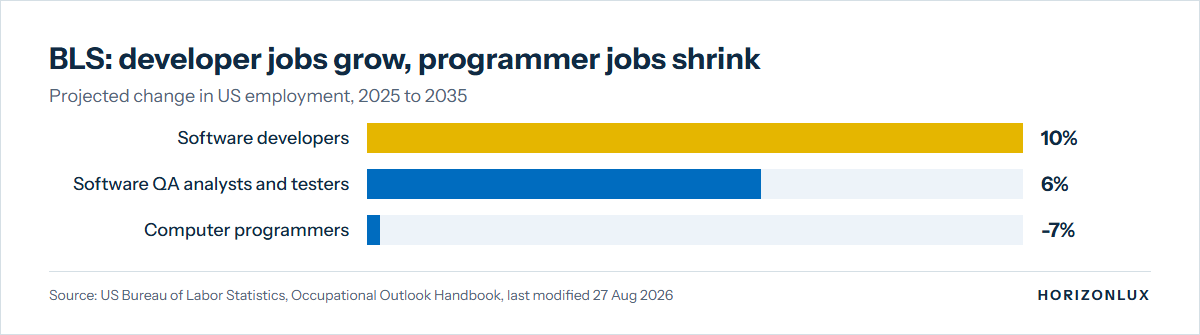 Source: US Bureau of Labor Statistics, Occupational Outlook Handbook, last modified 27 Aug 2026. Chart by HorizonLux.
Read the two together. The job of turning a spec into code is shrinking. The job of deciding what to build, checking it and shipping it is still growing.
How developers already use AI (Stack Overflow 2026)
AI tools are now the default at work. Trust in them depends on being able to check the output, and that checking is a large part of what a junior developer now does.
Stack Overflow’s 2026 Developer Survey results (6 October 2026) drew more than 30,000 respondents. Among developers who use AI, 66% use coding agents and 63% use chatbots. Of those using AI coding assistants or agents, 73% use them daily.
The trust figure is the one to note. 93% say that trusting what AI gives them requires source attribution. Developers want to see where an answer came from before they rely on it.
The annual survey does not break AI use down by career stage, and it asks no job-security question that we could find in the results post or on the full survey site.
A smaller Stack Overflow study does split by career stage. Its March 2026 article reports a February 2026 pulse survey of almost 900 respondents, designed with OpenAI. Daily AI use at work was 68% for early-career developers, 59% for mid-career and 56% for experienced developers. It is a separate, smaller sample, so treat it as a signal, not a census.
What GitHub sees (Octoverse 2026)
The amount of code and the number of developers both keep rising while agents start a growing share of the work.
GitHub’s Octoverse 2026 (published 28 October 2026, updated 6 November 2026) covers 1 October 2025 to 30 September 2026. GitHub serves more than 225 million developers as of September 2026, and 1.3 billion pull requests were merged in the 12 months.
Agents now start a large part of that work. As of September 2026, developers started more than 40% of pull requests with an agent, about 110 million in that month alone. In March 2026 the share was 17%.
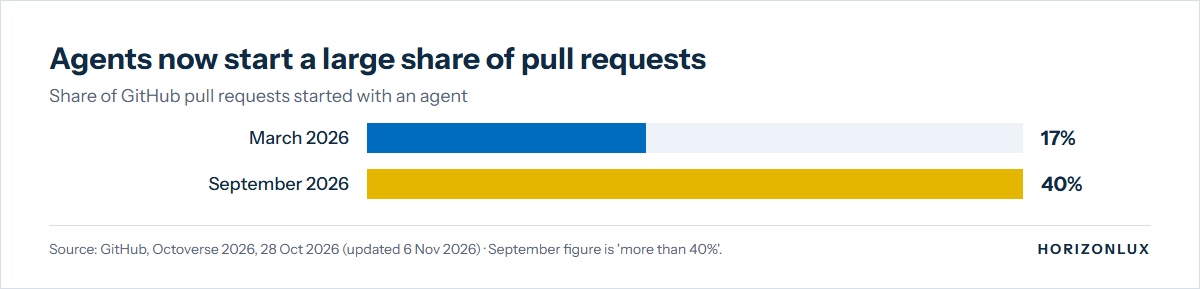 Source: GitHub, Octoverse 2026, 28 Oct 2026 (updated 6 Nov 2026). Chart by HorizonLux.
For context, the previous Octoverse reported more than 36 million new developers in the year to 31 August 2025. People are still joining, not leaving.
What the junior job becomes
The entry-level task is moving from writing boilerplate to reviewing, testing and directing what agents produce. That fits all four sources.
Stanford finds the losses where AI substitutes for the task and none where it complements the worker. BLS projects the routine-coding occupation to shrink and the broader developer role to grow. Stack Overflow shows developers will only trust output they can trace. GitHub shows agents opening a large share of pull requests, and every one of those still needs someone to review it.
So the junior who reads a diff closely, writes the test that catches the agent’s mistake and explains why a change is wrong is doing the work the data says is growing. Packaging that know-how so agents follow it is its own skill. Our guide to agent skills shows one way teams write it down.
There is also a supply problem. Senior engineers start as juniors. A team that stops hiring juniors now will have fewer people ready to lead in five years, whatever the agents can do by then.
What this means if you are hiring
Keep a junior pipeline, change what juniors do, and budget for experienced oversight of agent output.
- Hire juniors for review and evaluation work. Give them agent-generated pull requests to review, test suites to extend and evaluation sets to build. That is where judgment gets trained.
- Pair every agent with an owner. Someone experienced has to decide what the agent works on and sign off what it ships.
- Price the options honestly. Our AI agent vs human cost tool compares the running cost of an agent with a person for a given task. The hire, augment or outsource calculator helps you weigh a new hire against outside help.
If you need extra hands while you build that pipeline, AI staff augmentation adds an engineer to your existing team rather than replacing anyone on it. You can hire an AI engineer from $3,000/month, starting within ten working days, beginning with a paid pilot.
Frequently asked questions
Is AI reducing junior developer jobs?
The evidence points to slower hiring, not layoffs. Stanford’s August 2026 revision finds US workers aged 22 to 25 in AI-exposed occupations are 19% below where they would be had they kept pace with less-exposed peers, mainly through reduced hiring. The authors call this descriptive, not causal, and find no economy-wide displacement.
What does the BLS project for software developers?
Growth. The BLS Occupational Outlook Handbook, last modified 27 August 2026, projects software developer jobs to grow 10% from 2025 to 2035, from 1,717,800 jobs in 2025. Median pay was $135,980 in May 2025. Computer programmers, a separate and narrower occupation, are projected to decline 7%.
Is the Stanford “canaries” study about software developers?
Partly. It covers all AI-exposed occupations, and the authors name software development and customer service among the most exposed. The 19% figure applies to young workers across exposed occupations, not to software developers alone, and the paper’s text gives no separate headline figure for developers.
Do junior developers use AI more than seniors?
In one smaller study, yes. A Stack Overflow pulse survey of almost 900 respondents in February 2026 found daily AI use at work of 68% for early-career developers, 59% for mid-career and 56% for experienced developers. The larger 2026 annual survey does not report AI use by career stage.
What skills should junior developers learn now?
Learn to review and test code you did not write. Agents start more than 40% of pull requests on GitHub, and someone has to check each one. Reading diffs, writing tests, tracing a bug and explaining why a change is wrong are the skills that agent-heavy teams need most.
Should companies still hire junior developers?
Yes. Juniors are where your future senior engineers come from, and the review and testing work that agents create suits them well. BLS still projects 10% growth for software developers. A team that stops hiring juniors now will struggle to find people ready to lead later.
Sources
- Brynjolfsson, Chandar and Chen, “Canaries in the Coal Mine? Six Facts about the Recent Employment Effects of Artificial Intelligence”, Stanford Digital Economy Lab, revised 12 Aug 2026 (ADP data through June 2026). https://digitaleconomy.stanford.edu/publications/canaries-in-the-coal-mine/
- Same paper, August 2026 PDF (served at the November 2025 file address). https://digitaleconomy.stanford.edu/app/uploads/2025/11/CanariesintheCoalMine_Nov25.pdf
- US Bureau of Labor Statistics, Occupational Outlook Handbook, “Software Developers, Quality Assurance Analysts, and Testers”, last modified 27 Aug 2026. https://www.bls.gov/ooh/computer-and-information-technology/software-developers.htm
- US Bureau of Labor Statistics, Occupational Outlook Handbook, “Computer Programmers”, last modified 27 Aug 2026. https://www.bls.gov/ooh/computer-and-information-technology/computer-programmers.htm
- Stack Overflow, “The results of the 2026 Developer Survey are here”, 6 Oct 2026. https://stackoverflow.blog/2026/10/06/the-results-of-the-2026-developer-survey-are-here/
- Stack Overflow, 2026 Developer Survey (full results). https://survey.stackoverflow.co/2026/
- Stack Overflow, “Domain expertise still wanted: the latest trends in AI-assisted knowledge for developers”, 16 Mar 2026. https://stackoverflow.blog/2026/03/16/domain-expertise-still-wanted-the-latest-trends-in-ai/
- GitHub, “Octoverse: commits and pushes reach new highs in 2026 as developers build with agents”, 28 Oct 2026, updated 6 Nov 2026. https://github.blog/news-insights/octoverse/octoverse-commits-pushes-reach-new-highs-in-2026-as-developers-build-with-agents/
- GitHub, “Octoverse: a new developer joins GitHub every second as AI leads TypeScript to #1”, 2025. https://github.blog/news-insights/octoverse/octoverse-a-new-developer-joins-github-every-second-as-ai-leads-typescript-to-1/
Gaps and changes after re-reading: the outline’s 13%, 16%, 19% line was replaced. The 13% and 16% figures are confirmed in the August 2026 paper, but they are regression estimates from earlier versions, while 19% is a descriptive measure, so they are not one series. The chart now uses the paper’s like-for-like descriptive figures, 15% (July 2025 data) and 19% (June 2026 data). No software-developer-only Stanford figure appears in the paper’s text, so none is used. The 2026 Stack Overflow survey has no career-stage or job-security breakdown. Volume and KD are pending.