
If your company uses AI tools at work, Article 4 of the EU AI Act already applies to you. It has applied since 2 February 2025, and since 2 August 2026 a national authority can ask what you did about it.
This post is a practical reading of the text by a team that runs AI workshops and builds AI systems. It is not legal advice. Check what applies to you with your counsel.
TL;DR
- The duty is to take measures, not to reach a set level. The text amended in 2026 says it “does not require providers or deployers to guarantee any specific level of AI literacy of any individual.”
- It reaches more than employees. Contractors, service providers and others who use AI on your behalf count.
- No certificate and no test are required. The measures follow the role, the risk and the tools people actually use.
- Keep a record. It is not strictly required, but it is your answer if an authority asks.
- National market surveillance authorities supervise it, and penalties come from national law. Article 99 sets no fixed fine for Article 4.
What Article 4 says after the 2026 amendment
The current text of Article 4 on the Commission’s AI Act Service Desk is marked as amended by the 2026 Digital Omnibus on AI. It is based on the consolidated AI Act text as at 27 July 2026.
Article 4(1) now says providers and deployers “shall take measures to support the development of AI literacy of their staff and other persons dealing with the operation and use of AI systems on their behalf”.
Those measures take into account the people’s technical knowledge, experience, education and training, the context the AI is used in, and the people the AI is used on.
The same paragraph adds a limit: “This obligation does not require providers or deployers to guarantee any specific level of AI literacy of any individual.”
Article 4(2) puts a duty on the other side too. The Commission and the Member States must support providers and deployers, “in particular SMEs”, and the Commission must publish practical examples of how to comply.
Many guides on page one still quote the original 2024 wording. That wording changed in 2026. If a guide does not mention the amendment, read its advice with that in mind, and quote only the current text.
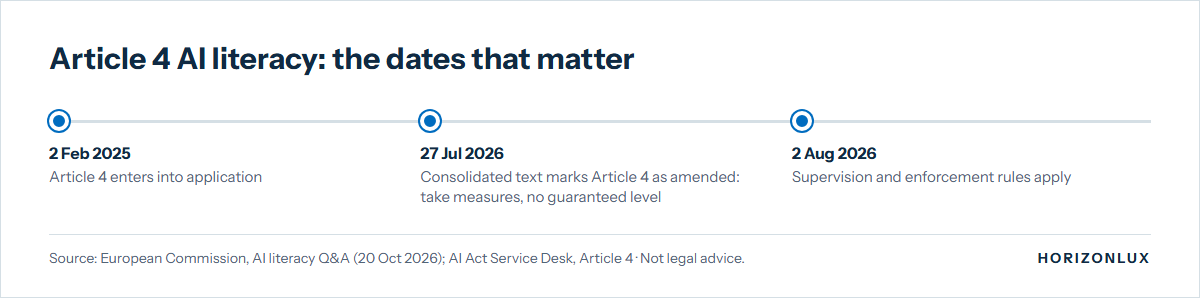 Source: European Commission, AI literacy questions and answers (20 Oct 2026), and AI Act Service Desk, Article 4, consolidated text as at 27 July 2026. Chart by HorizonLux.
Who counts as “staff and other persons”
The duty reaches anyone who operates or uses AI systems on your behalf, not only your employees.
The Commission’s AI literacy questions and answers, last updated on 20 October 2026, says the people concerned can be “persons broadly under the organisational remit”. Its examples are “a contractor, a service provider, a client.”
In practice, that means the agency writing your ads with an AI tool, the freelancer building your automations, and the outsourced support team using your chatbot console. If they use AI for you, plan for them too.
Here is how we group people when we plan training. It is our own working framework, not a legal standard.
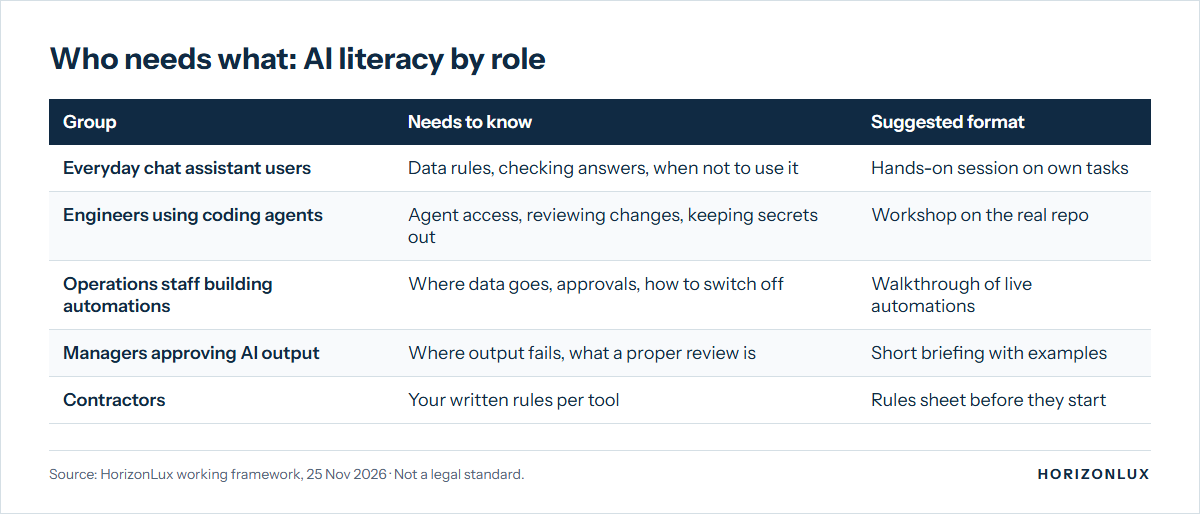 Source: HorizonLux working framework, 25 Nov 2026. Not a legal standard. Chart by HorizonLux.
Everyday users of chat assistants. They need to know what data they may paste in, how to check an answer, and when not to use the tool. A short session on their own tasks works better than a slide deck.
Engineers using coding agents. They need to know what the agent can reach, how to review its changes, and how to keep secrets and customer data out of prompts.
Operations staff building automations. They need to know where an automation sends data, who approves a new one, and how to switch it off.
Managers approving AI output. They need to know where the output can be wrong and what a proper review looks like before they sign off.
Contractors. They need your rules for each tool, in writing, before they start.
What counts as enough
There is no mandated level, no required certificate and no required test. The Commission Q&A says Article 4 “does not entail an obligation to measure the knowledge of AI of employees”, and: “There is no need for a certificate.”
That gives you room, and it puts the judgement on you. The measures should match the role, the risk and the tools people actually use. A team that only uses a chat assistant for drafting needs less than a team whose AI decides who gets a loan.
A four-step plan
- Inventory the AI tools in use and who uses them. Include the tools people signed up for themselves. Ask; do not rely only on the procurement list.
- Group people by role and risk. Use the five groups above as a start, then adjust to your company.
- Train on their own work, with data rules per tool. Use real tasks from their week. Write down what data may go into each tool and what may not.
- Re-check a few weeks later. Ask what people actually use, what went wrong, and whether the rules still fit. Update the record.
Our free AI readiness assessment helps with step one if you have not mapped your tools yet.
Deployers of high-risk systems have a separate, stricter duty
Article 4 is the floor. If you deploy a high-risk AI system, Article 26(2) adds a stronger rule for the people you put in charge of it.
It says deployers “shall assign human oversight to natural persons who have the necessary competence, training and authority, as well as the necessary support.”
That is a different test. Article 4 asks you to take measures. Article 26(2) asks that the named people actually have the competence and the authority to oversee the system.
The record to keep
A record is not strictly required, but it is the simplest proof that you took measures. The Commission Q&A says: “Organisations can keep an internal record of trainings and/or other guiding initiatives.”
Keep it short and dated. One row per session or initiative is enough. If an authority asks what you did, you send the record.
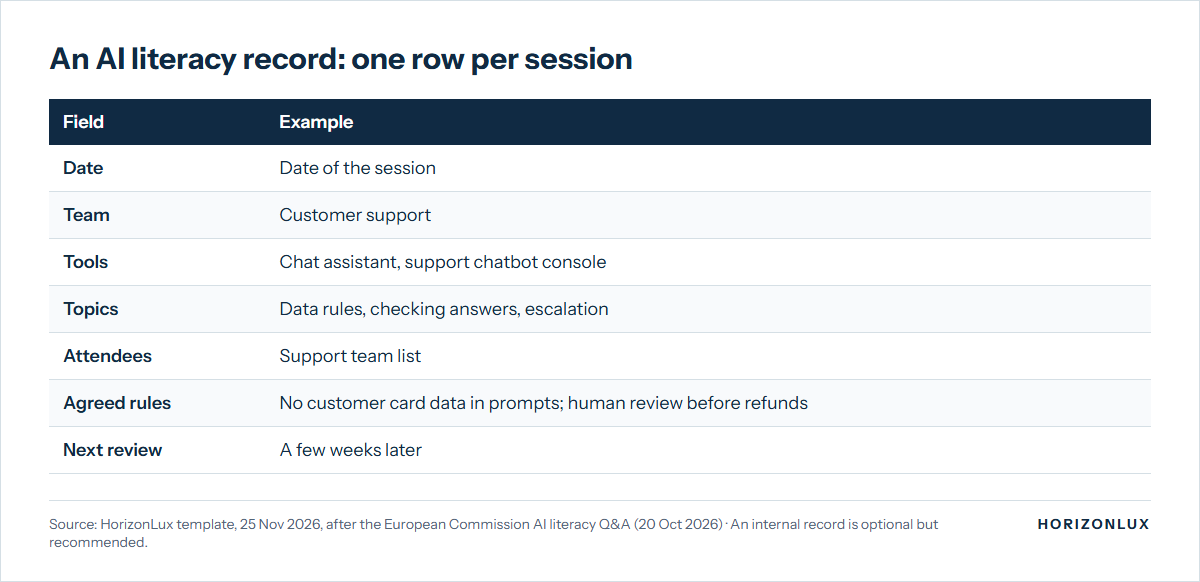 Source: HorizonLux template, 25 Nov 2026, based on the Commission’s AI literacy Q&A (20 Oct 2026). Chart by HorizonLux.
What to put in each row:
- Date of the session or initiative.
- Team or group, from your role map.
- Tools covered.
- Topics, in plain words: data rules, checking output, when not to use the tool.
- Attendees, by name or by team list.
- Agreed rules, the ones people signed up to.
- Next review date.
The agreed rules matter most. A rule written into the tool’s settings, such as a blocked data type or a required review step, is worth more than a slide people saw once.
Who enforces it, and what happens if you do nothing
National market surveillance authorities supervise Article 4, under national law. The Commission Q&A says supervision is “under the remit of national market surveillance authorities”, and that the supervision and enforcement rules apply from 2 August 2026 onwards.
The Q&A also says those authorities “could impose penalties” for infringements of Article 4, under national law.
There is no fixed EU fine for Article 4. Article 99 sets fine caps for other provisions, such as the prohibited practices and the Article 50 transparency rules, but not for Article 4. Member States still have to set penalties for any breach, and those must be proportionate.
So the risk of doing nothing is not a headline fine. It is an authority asking for your measures, and you having nothing to show. It also sits next to other duties: if an AI incident happens and your staff were never told the rules, that gap will show up in every other review.
If you want a quick view of where your company stands on this and the other AI Act duties, the free AI governance check takes a few minutes. Product teams that ship chatbots or generated content also have transparency duties under Article 50.
Where training helps most
The cheapest training is the one built on your team’s own work. A session where people use the AI tools on tasks from their real backlog, and leave with written rules for each tool, covers step three of the plan and gives you the record in the same hour.
That is how we run our AI workshops: on your own backlog and workflows, with the rules your team agrees written into the tools afterwards.
Frequently asked questions
Does the AI literacy rule apply to companies outside the EU?
It can. Article 4 applies to providers and deployers within the AI Act’s scope, and under Article 2 that includes companies outside the EU whose AI systems are placed on the EU market or whose output is used in the EU. Check your case with counsel.
Is AI literacy training mandatory?
Taking measures is mandatory. A specific course, a set level of knowledge, a test or a certificate is not. The Commission says Article 4 does not require measuring employees’ knowledge, and that no certificate is needed.
Did the 2026 Digital Omnibus remove the AI literacy duty?
No. The adopted text keeps the duty on providers and deployers. It now asks them to take measures to support AI literacy, and it says they do not have to guarantee any specific level for any individual.
What proof should we keep?
A dated record of what each team learned, who attended and the rules they agreed. The Commission says organisations can keep an internal record of trainings. No certificate is required.
Do contractors need training too?
If they operate or use AI systems on your behalf, yes. Article 4 covers “other persons”, and the Commission gives a contractor, a service provider and a client as examples of people under your organisational remit.
Is this legal advice?
No. HorizonLux runs AI workshops and builds AI systems. Your lawyer decides what your company must do.
Sources
- European Commission, “AI literacy: questions and answers”, last update 20 Oct 2026, read 26 Nov 2026, https://digital-strategy.ec.europa.eu/en/faqs/ai-literacy-questions-answers
- European Commission AI Act Service Desk, Article 4, consolidated text as at 27 Jul 2026, read 26 Nov 2026, https://ai-act-service-desk.ec.europa.eu/en/ai-act/article-4
- European Commission AI Act Service Desk, Article 26, consolidated text as at 27 Jul 2026, read 26 Nov 2026, https://ai-act-service-desk.ec.europa.eu/en/ai-act/article-26
- European Commission AI Act Service Desk, Article 99, consolidated text as at 27 Jul 2026, read 26 Nov 2026, https://ai-act-service-desk.ec.europa.eu/en/ai-act/article-99
- European Commission AI Act Service Desk, Article 2, consolidated text as at 27 Jul 2026, read 26 Nov 2026, https://ai-act-service-desk.ec.europa.eu/en/ai-act/article-2
Notes on sources:
- EUR-Lex (Regulation (EU) 2024/1689 and the Omnibus regulation) was tried again on 26 Nov 2026 in four formats and returned no readable text. The current Article 4 wording is from the Commission’s own Service Desk, based on the EUR-Lex consolidated version as at 27 July 2026.
- Left out because it could not be read at EUR-Lex: the original 2024 Article 4 wording (the outline’s before/after card). Graphic 1 is a dated timeline instead. Also left out: the Omnibus regulation’s number and Official Journal date.
- Left out: the Article 3(56) definition of AI literacy (not re-read at source).
- The Commission Q&A also describes the November 2025 proposal; it is quoted here only for scope, records and enforcement.