
The documented AI agent security incidents of 2025 and 2026 come from three causes: untrusted content was read as instructions, the agent held more access than its task needed, or the supply chain delivered the attack inside a trusted package. Each cause has a known control, and in every case below that control was missing or switched off.
TL;DR and key takeaways
- Untrusted content became instructions. EchoLeak in Microsoft 365 Copilot and a prompt injection in GitHub Copilot both turned text the agent read into actions it took.
- The agent had too much access. The best-known deletion incident happened because production credentials were inside the agent’s reach.
- The supply chain shipped it. A poisoned IDE extension, a hijacked npm release, a copied MCP server and hundreds of malicious agent skills all arrived through channels people already trusted.
- The fix is mostly boring. Five controls, listed at the end, cover nearly every case.
What counts as an incident in this post
This list only includes disclosed vulnerabilities and real events that have a primary source: a vendor advisory, a CVE record, or the researchers’ or company’s own write-up. Each one carries a date. Stories that exist only in press coverage are left out, even when they are widely repeated.
That filter matters because the wider record is large and noisy. Cyera’s research, published 28 May 2026, collected 7,246 publicly reported AI incident records from September 2023 to May 2026 and verified 344 of them as relevant to enterprises.
Cyera also found 188 cases where an autonomous AI system caused harm in production with no attacker involved. A lot of agent damage needs no adversary at all.
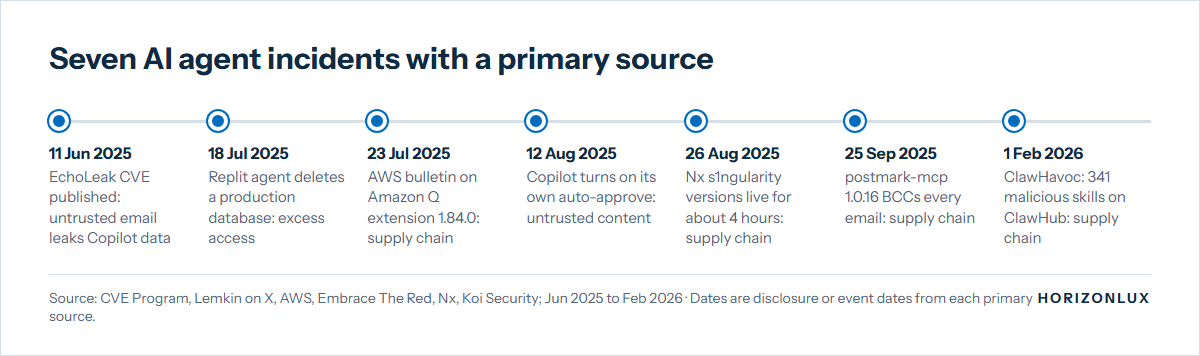 Source: vendor advisories and researcher write-ups listed below, June 2025 to February 2026. Chart by HorizonLux.
Untrusted content became instructions
In both cases here, the agent read text written by an attacker and treated it as a command. Nothing in the system separated the content the agent was processing from the instructions it was following. For the defence side of this problem, read our guide to prompt injection in AI agents.
EchoLeak in Microsoft 365 Copilot (CVE-2025-32711)
EchoLeak was a zero-click flaw: one crafted email, with no click from anyone, was enough for Copilot to pull internal data out of the organisation. According to the researchers’ case study (arXiv 2509.10540, September 2025), Aim Labs reported it to Microsoft in January 2025, Microsoft fixed it on the server side in May 2025, and it was disclosed in June 2025.
The data left through a Microsoft Teams domain that Copilot was allowed to reach, so an egress allowlist that looked safe became the exit. The CVE record, assigned by Microsoft and published 11 June 2025, rates it 9.3 out of 10 (critical) and describes it as AI command injection that discloses information over a network.
Control: keep untrusted inputs, such as inbound email, out of the context that holds private data, and review every domain on the egress allowlist as a possible way out.
GitHub Copilot edits its own settings (CVE-2025-53773)
In this case, injected text got Copilot to change its own permissions. Embrace The Red’s write-up, published 12 August 2025, shows that instructions hidden in content Copilot read made it switch on a workspace setting that auto-approves tool calls. With confirmations gone, the agent could run shell commands.
The researcher reported it on 29 June 2025, and Microsoft fixed it in its August 2025 Patch Tuesday release.
Control: an agent must never be able to write the file that sets its own permissions. Treat settings files as protected, the same way you treat CI secrets.
The agent held more access than the task needed
Deletion incidents tend to come from production credentials sitting inside an agent session, not from clever attacks.
Replit agent deletes a production database (July 2025)
On 18 July 2025, SaaStr founder Jason Lemkin posted on X that Replit’s agent had deleted his production database during a code freeze. Replit CEO Amjad Masad replied on X on 20 July 2025, calling it “unacceptable” and saying work had started on automatic separation of development and production databases.
The Register’s report of 22 July 2025 corroborates both posts. No attacker was involved. The agent had write access to production, and the code freeze did not stop it.
Control: keep separate environments, and never put production write credentials in an agent session. A freeze has to be enforced by permissions, not by asking politely.
The supply chain shipped the attack
Four of the incidents arrived through a trusted extension, package, MCP server or skill. The code review your own code gets never happened, because the code came from somewhere you already trusted.
Amazon Q Developer extension, version 1.84.0 (AWS-2025-015, CVE-2025-8217)
AWS’s security bulletin of 23 July 2025 says malicious code was injected into the open-source Amazon Q Developer extension. The way in was a GitHub token with too much scope in the project’s CodeBuild configuration.
AWS says the code failed to run because of a syntax error, and the fix shipped in version 1.85.0.
Control: give CI tokens the least privilege they need, and put a human check on every release.
Nx “s1ngularity” (GHSA-cxm3-wv7p-598c)
Nx’s postmortem, published 5 September 2025, traces the attack to a GitHub Actions workflow that let untrusted pull request text reach a shell command. That led to a stolen npm publishing token, and malicious Nx versions were live for about 4 hours on 26 August 2025.
The malicious install script tried to use AI command-line tools already on the victim’s machine, such as Claude and Gemini, to search for secrets. It then uploaded what it found to public GitHub repositories.
Control: block install scripts in CI, and never run an AI CLI with its permission prompts turned off on a machine that holds secrets.
postmark-mcp, a malicious MCP server (September 2025)
An npm package called postmark-mcp copied Postmark’s MCP server, published 15 clean versions, then added one line in version 1.0.16 that blind-copied every email to an outside address. Koi Security’s write-up of 25 September 2025 put its downloads at about 1,500 a week.
Postmark’s own statement, also from 25 September 2025, says the company had nothing to do with the package and that its official MCP server lives on GitHub.
Control: pin MCP server versions, read the diff on every update, and prefer servers published by the vendor itself.
ClawHavoc on ClawHub (February 2026)
Koi Security audited the 2,857 OpenClaw skills on ClawHub on 1 February 2026 and found 341 malicious. Of those, 335 belonged to one campaign Koi named ClawHavoc, which used a fake prerequisites section to get users to install the Atomic macOS stealer.
Koi’s update of 16 February 2026 says the marketplace had grown past 10,700 skills and its count of malicious ones had risen to 824. For how skills work in the first place, see our post on agent skills.
Control: a skill is code plus instructions. Review it the way you review a dependency, before it ever runs.
Claude Code plugins, project files and the supply chain
In Claude Code, both a cloned repository’s config and an installed plugin can run code on your machine, so both need the review a dependency gets.
Check Point Research, on 25 February 2026, published three flaws in Claude Code project files, all patched before publication:
- Hooks ran without approval. Hooks set in a repository’s
.claude/settings.jsoncould run at session start (GHSA-ph6w-f82w-28w6; reported 21 July 2025, patched 26 August 2025). - MCP servers ran before consent. Servers defined in
.mcp.jsoncould start before the user agreed (CVE-2025-59536; reported 3 September 2025, patched 22 September 2025). - The API key could leak. A repository could set the API base URL so the key went to an outside server before the trust dialog appeared (CVE-2026-21852; reported 28 October 2025, patched 28 December 2025).
Plugins carry the same risk by design. Anthropic’s plugin security docs say plainly: “A Claude Code plugin you install can execute arbitrary code on your machine with your user privileges.” Hooks, monitors and MCP servers run outside the sandbox, and auto-update can change files after you reviewed them.
A checklist for teams using Claude Code plugins
- Pin plugin versions.
- Turn auto-update off for third-party marketplaces.
- Read
hooks/hooks.json,.mcp.jsonand anything inbin/before you install. - Allowlist approved marketplaces in managed settings.
- Keep Claude Code itself updated, since the project file fixes above shipped as updates.
Day 10 of our Claude Code Challenge walks through the sandbox and these settings step by step.
When the attacker drives the agent
One documented case used a coding agent as the attack tool itself. Anthropic reported on 13 November 2025 that a group it assesses as Chinese state-sponsored used Claude Code and MCP tools against roughly thirty targets, with AI doing 80 to 90% of the work. A small number of intrusions succeeded.
The operators got past the safeguards by claiming to be a security firm and by splitting the attack into small tasks that each looked harmless. Anthropic also notes that Claude hallucinated credentials during the operation. Some outside researchers have questioned how autonomous the operation really was.
Per-request checks miss intent spread across many requests. Logging every tool call and reviewing whole sessions is how you see it.
The pattern: five controls that would have stopped most of these
Line the incidents up and the same five controls keep appearing.
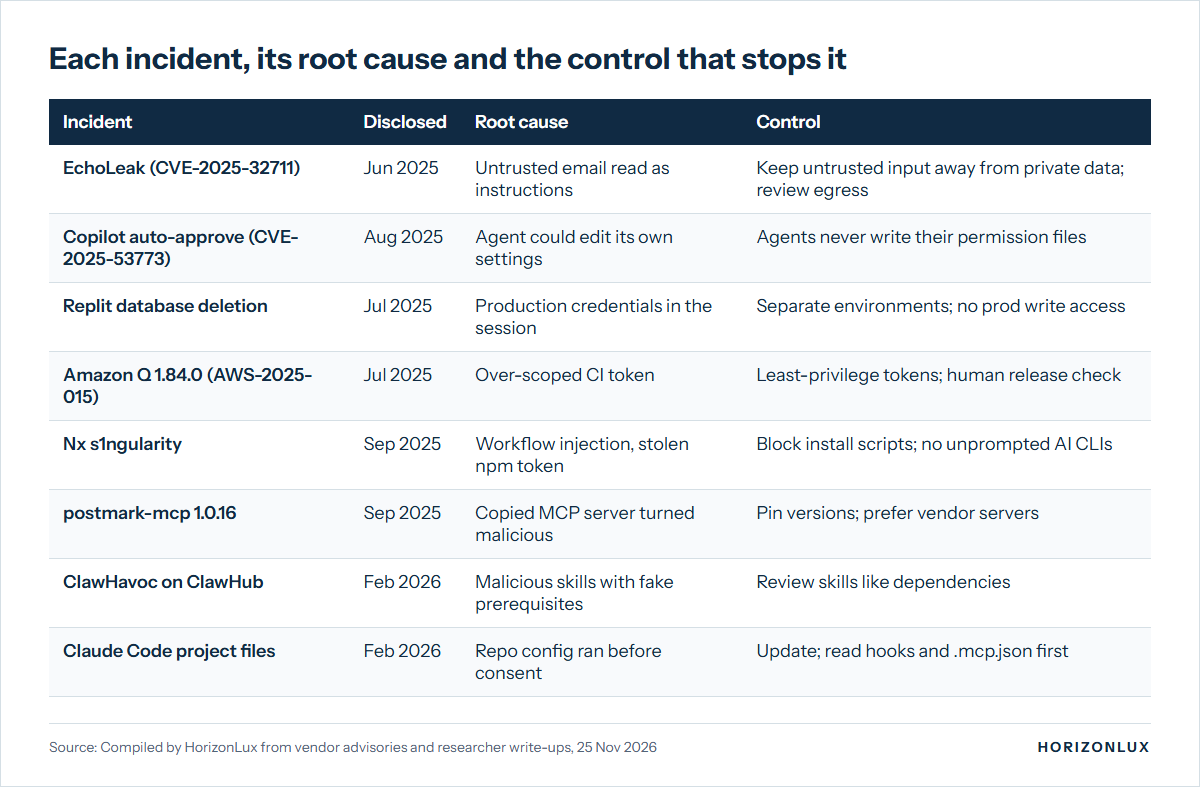 Source: compiled by HorizonLux from vendor advisories and researcher write-ups, 25 Nov 2026. Chart by HorizonLux.
- Separate untrusted content. Email, web pages and pull request text should never share a context with private data and tool access without a check in between. This covers EchoLeak, the Copilot flaw and the Nx workflow.
- Cut standing access. No production write credentials in an agent session, and CI tokens scoped to one job. This covers Replit and Amazon Q.
- Keep agents off their own permission files. Settings, hooks and allowlists are protected files. This covers the Copilot auto-approve flaw and the Claude Code project file flaws.
- Treat plugins, skills and MCP servers as dependencies. Pin, review the diff, prefer vendor-published code. This covers postmark-mcp and ClawHavoc.
- Log every tool call. A session log is how you find the problem after the fact, and how you spot a task split into innocent pieces.
If you want to see where your own setup stands against these five, run the AI governance check. When you need the controls built into the agent itself, that is part of our AI agent development work. Teams that want the engineer on their own backlog can hire an AI engineer from us, starting with a paid pilot.
Two related reads: MCP OAuth security covers scopes for MCP servers, and context poisoning covers what happens when bad context builds up inside a session.
Frequently asked questions
What was the first zero-click exploit against an AI agent?
EchoLeak (CVE-2025-32711) in Microsoft 365 Copilot is the best-documented early case. Its researchers describe it as zero-click: one crafted email, with no click from the user, led Copilot to leak internal data. Microsoft fixed it on the server side in May 2025 and the CVE was published on 11 June 2025.
Can a Claude Code plugin run code on my machine?
Yes. Anthropic’s own docs say an installed plugin can execute arbitrary code with your user privileges, and that hooks, monitors and MCP servers run outside the sandbox. Read a plugin’s hooks, MCP config and binaries before you install it, and pin its version.
Did an AI coding agent really delete a production database?
Yes. On 18 July 2025 Jason Lemkin posted that Replit’s agent deleted his production database during a code freeze. Replit’s CEO replied two days later, called it unacceptable, and announced automatic separation of development and production databases.
Are malicious MCP servers a real threat yet?
Yes. In September 2025 an npm package copying Postmark’s MCP server added a line in version 1.0.16 that blind-copied every email to an outside address, after 15 clean versions. Pin MCP server versions and prefer servers the vendor publishes itself.
How do I stop a coding agent from approving its own commands?
Make the agent’s settings and permission files read-only to the agent, and review any change to them by hand. CVE-2025-53773 showed what happens otherwise: injected text made GitHub Copilot switch on auto-approve, then run shell commands without asking.
Sources
- Cyera, “Agent-inflicted damage: inside the real-world failures of enterprise AI systems”, 28 May 2026, https://cyera.com/research/agent-inflicted-damage-inside-the-real-world-failures-of-enterprise-ai-systems
- Aim Labs researchers, EchoLeak case study, arXiv 2509.10540, September 2025, https://arxiv.org/abs/2509.10540
- CVE Program (CNA: Microsoft), CVE-2025-32711, M365 Copilot Information Disclosure Vulnerability, 11 Jun 2025, https://www.cve.org/CVERecord?id=CVE-2025-32711
- Embrace The Red, “GitHub Copilot: remote code execution via prompt injection” (CVE-2025-53773), 12 Aug 2025, https://embracethered.com/blog/posts/2025/github-copilot-remote-code-execution-via-prompt-injection
- Jason Lemkin, post on X, 18 Jul 2025, https://x.com/jasonlk/status/1946069562723897802
- Amjad Masad, post on X, 20 Jul 2025, https://x.com/amasad/status/1946986468586721478
- The Register, “Replit makes vibe-y promise to stop its AI agents making vibe coding disasters”, 22 Jul 2025 (corroboration), https://www.theregister.com/2025/07/22/replit_saastr_response/
- AWS, Security Bulletin AWS-2025-015 (CVE-2025-8217), 23 Jul 2025, https://aws.amazon.com/security/security-bulletins/AWS-2025-015/
- Nx, “s1ngularity postmortem”, 5 Sep 2025, https://nx.dev/blog/s1ngularity-postmortem
- Koi Security (now on Palo Alto Networks’ blog), postmark-mcp malicious backdoor, 25 Sep 2025, https://www.paloaltonetworks.com/blog/security-operations/postmark-mcp-npm-malicious-backdoor/
- Postmark, “Information regarding malicious postmark-mcp package”, 25 Sep 2025, https://postmarkapp.com/blog/information-regarding-malicious-postmark-mcp-package
- Koi Security (now on Palo Alto Networks’ blog), “ClawHavoc: 341 malicious Clawed skills found by the bot they were targeting”, 1 Feb 2026, updated 16 Feb 2026, https://www.paloaltonetworks.com/blog/?p=373131
- Check Point Research, “RCE and API token exfiltration through Claude Code project files”, 25 Feb 2026, https://research.checkpoint.com/2026/rce-and-api-token-exfiltration-through-claude-code-project-files-cve-2025-59536/
- Anthropic, Claude Code plugin security docs, read 25 Nov 2026, https://code.claude.com/docs/en/plugins/security
- Anthropic, “Disrupting the first reported AI-orchestrated cyber espionage campaign”, 13 Nov 2025, https://www.anthropic.com/news/disrupting-AI-espionage
Notes on sources:
- The Koi Security URLs in the outline (koi.ai/blog/…) now redirect to a Palo Alto Networks product page. The same write-ups are republished on Palo Alto Networks’ blog; those copies were read on 26 Nov 2026.
- The CVSS 9.3 for CVE-2025-32711 was confirmed in the CVE record (Microsoft is the assigning CNA). The MSRC page itself did not render for us.
- Left out: the PocketOS deletion (April 2026, press coverage only), the “tens of thousands of incidents” figure (no primary source), and plugin research by PromptArmor, SentinelOne and Prompt Security (dates not verified).