
Article 50 of the EU AI Act has applied since 2 August 2026, and it covers ordinary AI products: chatbots, voice agents, and image, audio, video and text generators. If people in the EU talk to your AI or see what it makes, you probably have at least one Article 50 duty today.
This is an engineer’s reading of the text, written by people who build these features. It is not legal advice. Check what applies to you with your counsel.
TL;DR
- Four duties. Tell people they are talking to AI, mark generated content in a machine-readable way, tell people about emotion recognition or biometric categorisation, and label deepfakes and some public-interest text.
- Two roles. Providers build the system, deployers use it professionally. A company that ships its own chatbot on a bought model is usually both.
- The date did not move. The 2026 Digital Omnibus delayed the high-risk rules, not Article 50. The only extra time is for marking output from generative systems already on the market, until 2 December 2026.
- Fines for Article 50 reach EUR 15 million or 3% of worldwide annual turnover, whichever is higher, and the lower of the two for SMEs and start-ups.
The four duties, and who carries each one
Article 50 splits the work between providers, who build and place the system on the market, and deployers, who use it in their business. Most product teams carry duties on both sides. The text below follows the Commission’s AI Act Service Desk version of Article 50, which is based on the consolidated AI Act text as at 27 July 2026.
50(1), providers: say it is AI. A system meant to interact with people must be designed so that they are “informed that they are interacting with an AI system”. This does not apply when that is obvious from the context.
50(2), providers: mark the output. Systems that generate synthetic audio, image, video or text must make the output “marked in a machine-readable format and detectable as artificially generated or manipulated”, as far as technically feasible.
50(3), deployers: tell people about emotion recognition and biometric categorisation. If you run either kind of system, you must inform the people exposed to it, and process their personal data under EU data protection law.
50(4), deployers: label deepfakes and some text. You must disclose that deepfake image, audio or video content is artificially generated or manipulated. The same applies to AI-generated text published to inform the public on matters of public interest, unless a person reviewed it, or it was under editorial control, and someone holds editorial responsibility.
50(5), everyone: when and how. The information must be given “in a clear and distinguishable manner at the latest at the time of the first interaction or exposure”, and it must meet accessibility requirements.
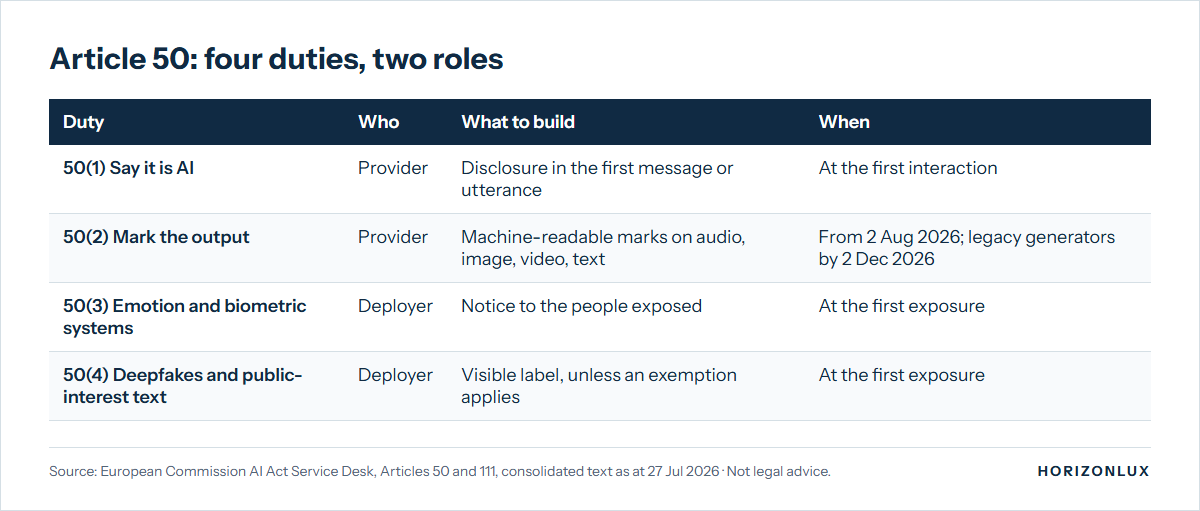 Source: European Commission AI Act Service Desk, Article 50, consolidated text as at 27 July 2026. Chart by HorizonLux.
Provider or deployer: a quick test
If you put the AI system on the market or into service under your own name, you are a provider. If you use an AI system in your business, you are a deployer.
The common case is both. Say you build a support chatbot on a model you buy from a lab and put it on your website. You are the provider of that chatbot, so 50(1) is yours. You also use it in your business, so any deployer duty that fits is yours too.
The model lab carries its own obligations. They do not replace yours for the product you ship.
The dates after the 2026 Digital Omnibus
The Digital Omnibus on AI changed the timetable for high-risk systems. It did not move Article 50.
The Commission’s Article 50 FAQ, last updated on 24 July 2026, says it plainly: “Article 50 of the AI Act applies as from 2 August 2026.”
The one extra window is in the new Article 111(4). Providers of systems that generate synthetic audio, image, video or text, and that were placed on the market before 2 August 2026, must comply with Article 50(2) by 2 December 2026.
That grace period is narrow. The Commission FAQ says it is “only for AI systems placed on the market before 2 August 2026”. A generator you launch now gets no extra time, and the grace period covers marking only, not the 50(1) disclosure.
There is good news on old content. The same FAQ says: “Content generated prior to 2 August 2026 does not need to be labelled retroactively.”
For contrast, the high-risk rules now start later. According to the Commission’s press release of 7 May 2026, stand-alone high-risk areas such as biometrics, critical infrastructure, education and employment apply from 2 December 2027. High-risk AI in products such as lifts or toys applies from 2 August 2028.
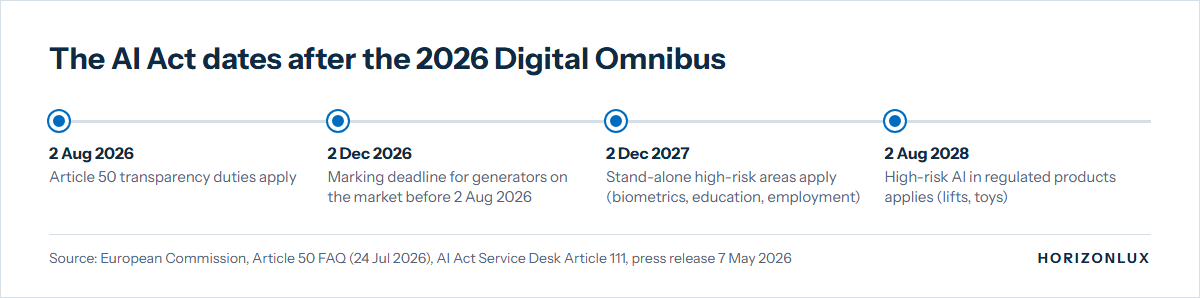 Source: European Commission, Article 50 FAQ (24 July 2026), AI Act Service Desk Article 111, press release of 7 May 2026. Chart by HorizonLux.
What to build: a checklist per duty
Each duty maps to a small, testable engineering change. The rule that ties them together is timing: the disclosure has to happen before or at the first interaction, not in a footer or a terms page.
Chatbots and voice agents (50(1))
- Put the disclosure in the first message of a chat, or the first sentence a voice agent speaks.
- Keep it in the transcript, so you can show later what the user saw.
- Treat it as a product string under test. A CI check that fails when the first message has no disclosure costs minutes to write.
- Check every entry point: the web widget, the WhatsApp channel, the phone line, the embedded agent inside a partner’s app.
The exception is when it is obvious to the person that they are talking to AI. Do not lean on it for a support bot that has a human name and a human photo.
Generated images, audio, video and text (50(2))
- Add machine-readable marks to the output: metadata, watermarks, or both, depending on the format.
- Keep the mark in every export path. A download button that strips metadata, or a resize step that drops it, breaks compliance silently.
- Write a test that generates an asset, exports it the way a user would, and checks the mark is still there.
- Know the exemptions. The duty does not cover systems that perform an assistive function for standard editing, or systems that do not substantially alter the input data.
The Commission points to its Code of Practice on transparency of AI-generated content as a voluntary route. Its FAQ says: “The code has been assessed as adequate by both the Commission and the AI Board.” Following it is a reasonable starting point for your marking design.
Deepfakes and public-interest text (50(4))
- Add a visible label to deepfake image, audio and video content.
- For work that is evidently artistic, creative, satirical or fictional, the disclosure can be limited to saying the content exists, in a way that does not spoil the work.
- For AI-generated text published to inform the public on matters of public interest, label it unless a person reviewed it or it was under editorial control, and someone holds editorial responsibility. Record that review, so the exemption is provable.
Emotion recognition and biometric categorisation (50(3))
- Tell the person, at the first exposure, that the system is running.
- Do your GDPR work as well. Article 50 sits on top of data protection law; it does not replace it.
If you are not sure which of these your product touches, our free AI governance check walks through the questions in a few minutes.
Exemptions people get wrong
Several things sit outside Article 50 or are exempt from it. Teams often get these wrong in both directions.
Obvious interactions. The Commission FAQ says: “People do not need to be informed when it is obvious they are interacting with an AI system.” The test is what a reasonably well-informed person would think, not what your team thinks.
Standard editing tools. The marking duty “does not apply when the AI system performs an assistive function for standard editing”, according to the FAQ. Spell-check and light grammar help are the clear cases.
Personal, non-professional use. The FAQ says such use “is excluded from the scope of the AI Act.” Your staff using AI at work is professional use.
Human-edited public-interest text. Text that a person reviewed, with someone holding editorial responsibility, is exempt from the 50(4) text label.
The grey area: marketing copy. Copy written by AI and then edited by a person is the case teams ask about most. Most marketing copy is not published “to inform the public on matters of public interest”, so 50(4) may not reach it at all. Where it might, the human review and editorial responsibility exemption is the one to document. Ask your counsel about borderline cases.
Fines and who enforces
National market surveillance authorities enforce Article 50. The Commission FAQ says compliance “will mainly be enforced by national competent market surveillance authorities.”
Under Article 99(4)(g), breaching the transparency obligations in Article 50 can bring fines of up to EUR 15 million or up to 3% of total worldwide annual turnover for the preceding financial year, whichever is higher.
Article 99(6) flips that for smaller firms. For SMEs, including start-ups, each fine is capped at the percentage or the amount, whichever is lower.
The engineering work is small next to that exposure. A disclosure string, a metadata step and a few tests are days of work, not months.
Where to start this week
- List every AI surface that talks to people or produces content: chat, voice, email drafting, image generation, summaries published on your site.
- Mark each one provider, deployer or both, and note which of the four duties applies.
- Check the first interaction on each surface. Is the disclosure there, before or at the first message?
- Test the marking on every export path of every generator.
- Write down your exemptions and the reason for each, so you can answer a regulator’s question in one email.
If you want help deciding what to build first, our AI strategy consulting work starts with exactly this list. If you already know what to build and need someone to build it inside your product, you can hire an AI engineer who ships it into your repo. Staff training is a separate duty under Article 4; our post on AI literacy covers it.
Frequently asked questions
Did the Digital Omnibus delay Article 50?
No. It delayed the high-risk rules. Article 50 applies from 2 August 2026. Only the 50(2) marking duty for generative systems placed on the market before that date gets extra time, until 2 December 2026.
Does my customer-support chatbot need an AI disclosure?
Yes, unless it is obvious to a reasonably well-informed person that they are talking to AI. Give the disclosure at the latest at the first interaction, in a clear way, and keep it in the transcript.
Do I need to label content we generated before August 2026?
No. The Commission’s Article 50 FAQ says content generated before 2 August 2026 does not need to be labelled retroactively. New output from that date on falls under the rules.
Does AI-written marketing copy need a label?
Usually not under 50(4), which covers text published to inform the public on matters of public interest. Even that text is exempt when a person reviewed it and someone holds editorial responsibility. Ask your counsel about borderline cases.
Does Article 50 apply to a US company?
It can. Under Article 2, the AI Act covers providers placing AI systems on the EU market whether they are based in the EU or not. It also covers providers and deployers outside the EU when the system’s output is used in the EU.
Is this legal advice?
No. HorizonLux engineers build disclosure, marking and logging features. Your lawyer decides what applies to your company and your products.
Sources
- European Commission, “Transparency obligations under Article 50 of the AI Act” (FAQ), last update 24 Jul 2026, read 26 Nov 2026, https://digital-strategy.ec.europa.eu/en/faqs/transparency-obligations-under-article-50-ai-act
- European Commission AI Act Service Desk, Article 50, consolidated text as at 27 Jul 2026, read 26 Nov 2026, https://ai-act-service-desk.ec.europa.eu/en/ai-act/article-50
- European Commission AI Act Service Desk, Article 111, consolidated text as at 27 Jul 2026, read 26 Nov 2026, https://ai-act-service-desk.ec.europa.eu/en/ai-act/article-111
- European Commission AI Act Service Desk, Article 99, consolidated text as at 27 Jul 2026, read 26 Nov 2026, https://ai-act-service-desk.ec.europa.eu/en/ai-act/article-99
- European Commission AI Act Service Desk, Article 2, consolidated text as at 27 Jul 2026, read 26 Nov 2026, https://ai-act-service-desk.ec.europa.eu/en/ai-act/article-2
- European Commission, “EU agrees to simplify AI rules to boost innovation and ban nudification apps to protect citizens”, press release, 7 May 2026, https://digital-strategy.ec.europa.eu/en/news/eu-agrees-simplify-ai-rules-boost-innovation-and-ban-nudification-apps-protect-citizens
Notes on sources:
- EUR-Lex (Regulation (EU) 2024/1689 and the Omnibus regulation) was tried again on 26 Nov 2026 in four formats and returned no readable text. The article wording above is from the Commission’s own Service Desk, which states it is based on the EUR-Lex consolidated version as at 27 July 2026.
- Left out because they could not be read at EUR-Lex: the Omnibus regulation’s number and Official Journal date, and its entry-into-force date (the outline had it from law-firm alerts only).
- Left out: publication dates of the Commission’s transparency guidelines and Code of Practice (no Commission page gives them).