
The closest US government occupation to an AI engineer, computer and information research scientists, paid a median of $140,300 in May 2025. Self-reported pay on Levels.fyi is higher: a median total compensation of $155,000 for AI engineers in the United States.
AI engineer salary in the US, in one paragraph
The US Bureau of Labor Statistics says “the median annual wage for computer and information research scientists was $140,300 in May 2025” (BLS Occupational Outlook Handbook). That is base pay, from employer surveys.
Levels.fyi, which collects pay that engineers report themselves, shows a median total compensation of $155,000 for the AI engineer title in the United States, from 331 reports, on a page updated on 25 Nov 2026 (Levels.fyi). Total compensation includes stock and bonus, which is one reason it runs higher.
On the same Levels.fyi page, the 25th percentile is $109,000, the 75th is $212,000 and the 90th is $280,000.
Why BLS has no AI engineer line
BLS has no occupation code called “AI engineer”. It classifies the work under existing codes, so any government figure for AI engineers is a proxy. You should always ask which one.
Three codes cover most AI engineering work. Their May 2025 medians, from the BLS Occupational Outlook Handbook:
- Computer and information research scientists: $140,300 (BLS).
- Software developers: $135,980 (BLS).
- Data scientists: $120,230 (BLS).
Which one fits depends on the job. An engineer who builds agents and integrations on top of existing models looks more like a software developer. One who trains and evaluates models looks more like a research scientist.
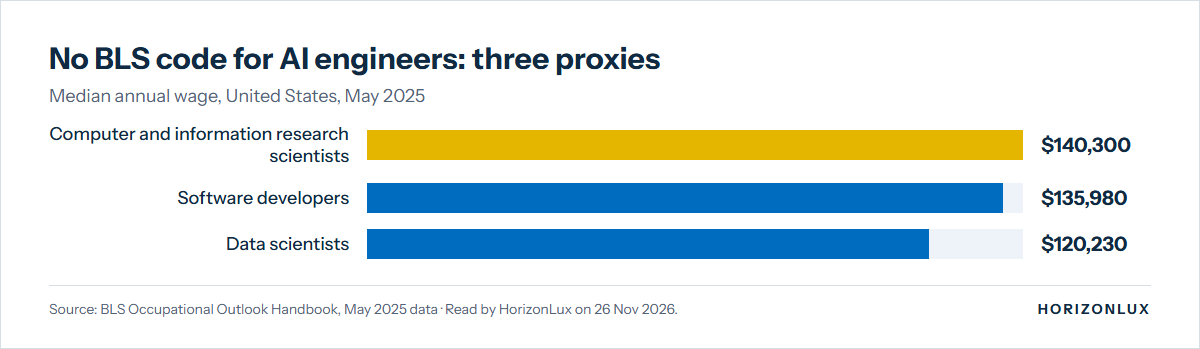 Source: BLS Occupational Outlook Handbook, May 2025 data, read 26 Nov 2026. Chart by HorizonLux.
Salary by percentile and level
The spread inside one occupation is far wider than the gap between occupations. The three medians above sit about $20,000 apart. Inside the research scientist code alone, the gap from bottom to top is nearly $150,000.
BLS says the lowest 10 percent of computer and information research scientists earned less than $82,200 in May 2025, and the highest 10 percent earned more than $230,630 (BLS).
Level explains much of that spread, and the AI premium grows with level. In a post dated 17 Jul 2025, Levels.fyi reported that AI engineers earned about 6.2% more than non-AI engineers at entry level, 11.9% at engineer level, 14.2% at senior and 18.7% at staff.
So the premium for AI skills is real, but modest at the start of a career. It roughly triples by staff level.
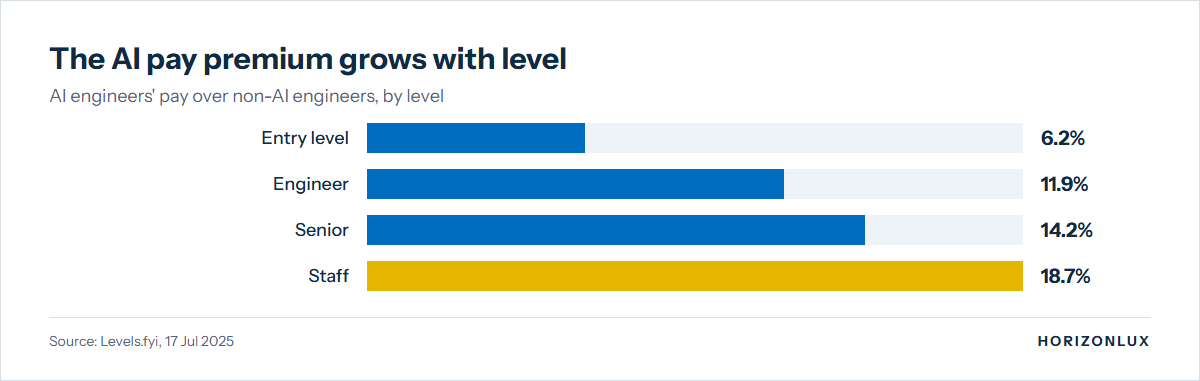 Source: Levels.fyi, 17 Jul 2025. Chart by HorizonLux.
What a hire costs on top of salary
Salary is only part of what you pay. Benefits add about 46% on top of wages for US professional jobs, and recruiting comes on top of that.
The BLS Employer Costs for Employee Compensation table for June 2026 puts private-industry management, professional and related jobs at $54.06 an hour in wages and $24.82 in benefits. Benefits are 45.9% on top of wages.
Recruiting has its own cost. SHRM’s 2025 benchmarking release, dated 15 Oct 2025, put the average cost per hire for non-executive roles at $5,475.
Then there is time. SHRM’s 2026 recruiting benchmarking brief says time to fill has fallen to a median of 39 calendar days for non-executive positions. That is across all roles, not AI roles alone, and it does not include the new hire’s notice period.
A worked example
Here is HorizonLux’s arithmetic on those BLS and SHRM figures, for one hire at the research scientist median:
| Cost | Per year | Source |
|---|---|---|
| Salary | $140,300 | BLS OOH, May 2025 |
| Benefits at 45.9% | about $64,400 | BLS ECEC, June 2026 |
| Salary plus benefits | about $204,700 (about $17,060 a month) | HorizonLux calculation |
| Recruiting, one-off | $5,475 average | SHRM, 2025 |
That is before equipment, management time and the weeks the role sits empty. It is a national median for a proxy occupation, so your number will differ by city, level and company.
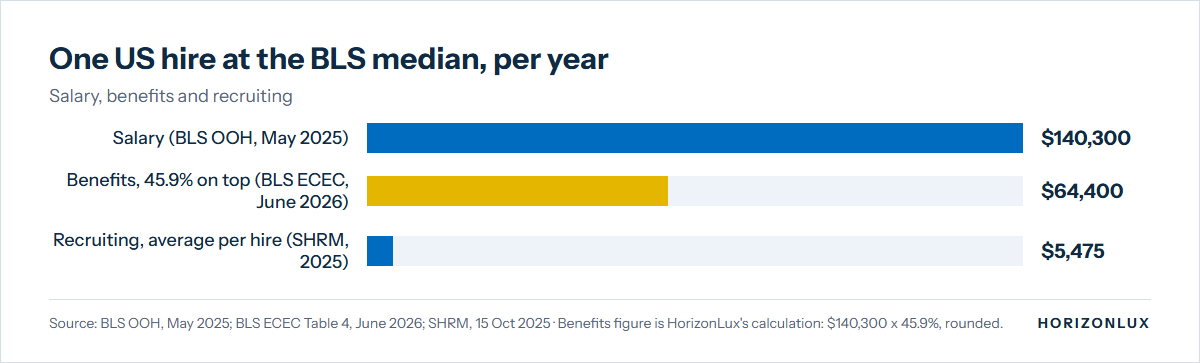 Source: BLS OOH (May 2025), BLS ECEC (June 2026), SHRM (15 Oct 2025). Calculation and chart by HorizonLux.
Embedded engineer vs freelancer vs full-time hire
The three ways to get an AI engineer differ more on who carries recruiting, benefits and the risk of a bad fit than on the headline rate.
| Full-time hire | Freelancer | Embedded engineer (HorizonLux) | |
|---|---|---|---|
| Who employs them | You | They are self-employed | HorizonLux |
| Who recruits | You | You vet each one | HorizonLux |
| Time to start | 39-day median to fill (SHRM, 2026), then notice | As fast as you find and vet someone | Within ten working days |
| Benefits | You pay, about 46% on top of wages (BLS) | None from you | Included in the monthly price |
| Exit | Notice period and employment law | Whatever the contract says | 30 days’ notice after a paid pilot |
| Where the code lives | Your repo | Depends on the contract | Your repo from day one |
We found no primary source for freelance AI engineer rates, so this table gives none. Marketplace rate pages either blocked our reads or reported vendor estimates.
A full-time hire makes sense when the role is core for years and the start date can wait. A freelancer fits a small task you can check yourself. An embedded engineer fits when you have a backlog now and want someone working in your tools without running a search.
If that last case is yours, you can hire an AI engineer from HorizonLux from $3,000/month. The exact price is agreed on the free call, the engineer joins within ten working days, and the work starts with a paid pilot. If you already have a technical lead who will direct the work, AI staff augmentation is the closer fit.
These two numbers are not like for like. The BLS figure is a US median for a proxy occupation. Our price is a starting price, agreed per client.
Work out your own number
Your location, level and how long you need the engineer change the answer more than any national median. The AI team cost calculator does the sum with the same BLS data, for your own inputs.
Pick the roles, their level and how many months you need, from 6 to 36. Salaries start from BLS figures, and you can type your own if you hire outside the US. It shows the total for hiring full-time, augmenting and outsourcing, and when full-time hiring catches up.
Frequently asked questions
How much does an AI engineer make in the US?
BLS has no AI engineer code. Its closest occupation, computer and information research scientists, paid a median of $140,300 in May 2025. Levels.fyi shows a median total compensation of $155,000 for the AI engineer title in the US.
Is an AI engineer paid more than a software engineer?
Usually, yes. Levels.fyi reported in July 2025 that AI engineers earned about 6.2% more than non-AI engineers at entry level and 18.7% more at staff level.
What is the total cost of hiring an AI engineer?
For a US hire at the BLS research scientist median, salary plus benefits comes to about $204,700 a year by HorizonLux’s arithmetic on BLS data. Add recruiting, which SHRM puts at $5,475 on average for non-executive roles.
Why do salary sites show different AI engineer salaries?
They measure different things. BLS reports base wages from employer surveys under broad codes. Levels.fyi reports total compensation, including stock, from engineers who choose to share it. For a title like forward deployed engineer, see our forward deployed engineer pay explorer, built from filed wages.
Can I hire an AI engineer without a full-time salary?
Yes. A freelancer works per task, and an embedded engineer from a partner works on your backlog for a monthly fee. HorizonLux’s embedded engineer starts from $3,000/month, with a paid pilot first and 30 days’ notice after it.
Sources
- US Bureau of Labor Statistics, Occupational Outlook Handbook, “Computer and Information Research Scientists”, May 2025 data, read 26 Nov 2026. https://www.bls.gov/ooh/computer-and-information-technology/computer-and-information-research-scientists.htm
- US Bureau of Labor Statistics, Occupational Outlook Handbook, “Software Developers”, May 2025 data, read 26 Nov 2026. https://www.bls.gov/ooh/computer-and-information-technology/software-developers.htm
- US Bureau of Labor Statistics, Occupational Outlook Handbook, “Data Scientists”, May 2025 data, read 26 Nov 2026. https://www.bls.gov/ooh/math/data-scientists.htm
- US Bureau of Labor Statistics, Employer Costs for Employee Compensation, Table 4, June 2026, read 26 Nov 2026. https://www.bls.gov/news.release/ecec.t04.htm
- Levels.fyi, “AI Engineer Salary in United States”, updated 25 Nov 2026. https://www.levels.fyi/t/software-engineer/title/ai-engineer/locations/united-states
- Levels.fyi, “AI Engineer Compensation Trends Q3 2025”, 17 Jul 2025. https://www.levels.fyi/blog/ai-engineer-compensation-trends-q3-2025.html
- SHRM, “SHRM Releases 2025 Benchmarking Reports”, 15 Oct 2025. https://www.shrm.org/about/press-room/shrm-releases-2025-benchmarking-reports–how-does-your-organizat
- SHRM, “2026 Recruiting Executives Benchmarking” data brief, read 26 Nov 2026. https://www.shrm.org/topics-tools/research/recruiting-benchmarking
- Dropped: the 44-day median time to fill recorded in the repo from SHRM’s 2025 PDF. The PDF was too large to open on 26 Nov 2026, and SHRM’s current page gives 39 days (2026 brief), so the post uses 39 only.
- Dropped: OEWS 25th and 75th percentiles from the repo file (not shown on bls.gov to WebFetch); the post uses the 10th and 90th percentiles BLS prints on the OOH page.
- Gaps: Glassdoor blocked automated reads (not used). Freelance AI rates: no primary source found.