
The AI code review bottleneck is the queue that forms when AI tools raise how much code a team writes faster than the team can review it. The data shows more and bigger pull requests, longer reviews and flat company-level delivery, so fix the queue itself (size, order, automated checks, reviewer time) before you buy a review tool.
TL;DR and key takeaways
- Output went up. Teams with high AI adoption merge far more pull requests, and each one is bigger.
- Review time went up faster. In the largest telemetry study, review time nearly doubled.
- Delivery did not follow. No large dataset shows company-level delivery improving in step, and delivery stability still suffers.
- Developers feel it. In a 2026 vendor survey, most say the bottleneck has moved from writing code to reviewing it.
- Fix inputs before tools. Smaller PRs, checks before a human looks, a review packet from the author, and protected review time.
The numbers, in date order
Every large dataset since 2024 shows individual output up and team delivery flat or less stable.
DORA 2024. Google Cloud’s DORA report, announced 23 October 2024, found that a 25% increase in AI adoption was associated with a 3.1% increase in code review speed and a 3.4% increase in code quality. As AI adoption increased, it was also accompanied by an estimated 1.5% decrease in delivery throughput and a 7.2% reduction in delivery stability.
METR, July 2025. In METR’s randomised trial, published 10 July 2025, 16 experienced open-source developers worked on 246 real tasks. With AI tools allowed, they took 19% longer, even though they had expected AI to speed them up by 24%. METR now says these results are out of date and points to a February 2026 update.
Faros AI, July 2025. Faros AI’s AI Productivity Paradox report, published 23 July 2025, drew on telemetry from over 10,000 developers across 1,255 teams. Developers on teams with high AI adoption completed 21% more tasks and merged 98% more pull requests, but PR review time rose 91%.
The same report found average PR size up 154% and bugs per developer up 9%. Faros “observed no significant correlation between AI adoption and improvements at the company level.”
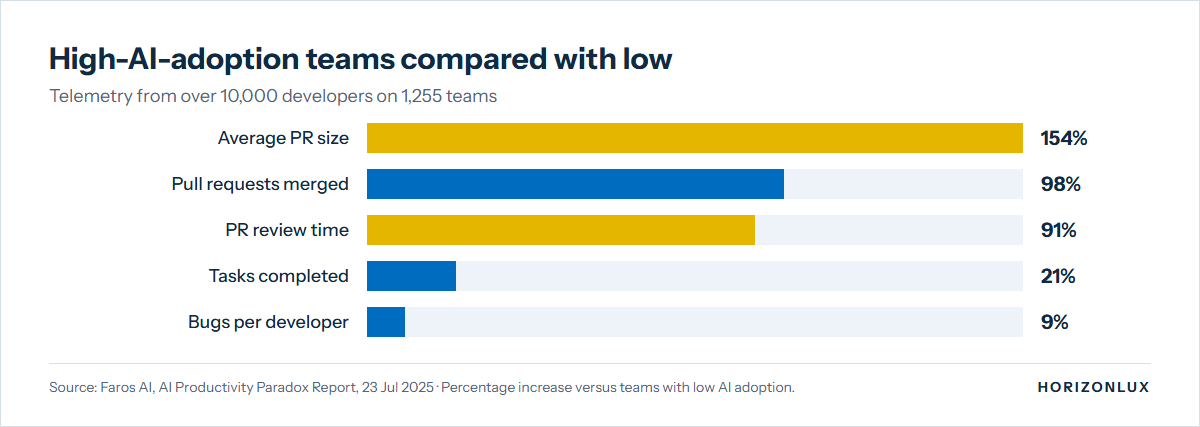 Source: Faros AI, AI Productivity Paradox Report, 23 Jul 2025. Chart by HorizonLux.
DORA 2025. The 2025 DORA report, announced 23 September 2025, surveyed nearly 5,000 technology professionals. 90% use AI at work. AI adoption now has a positive relationship with delivery throughput, but still a negative one with delivery stability, and 30% report little or no trust in AI-generated code.
GitLab, June 2026. GitLab’s AI Accountability Report, released 23 June 2026, surveyed 1,528 developers and technology buyers in six countries through The Harris Poll. 85% agree AI has shifted the bottleneck from writing code to reviewing and validating it. 79% say individual productivity has improved but the delivery process has not kept pace. This is a vendor survey of self-reported views.
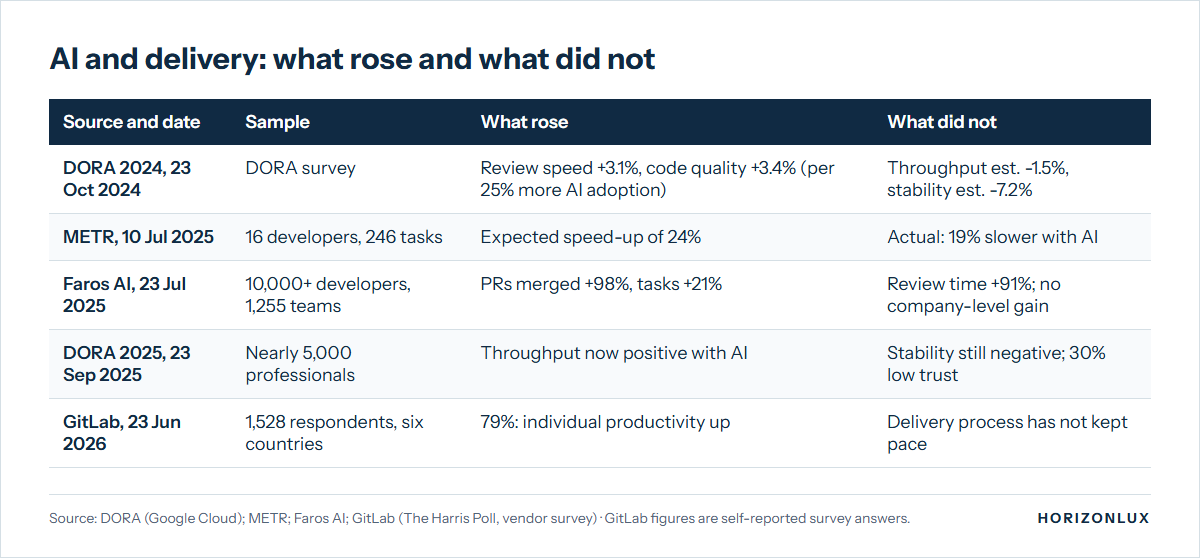 Source: DORA (Google Cloud), 23 Oct 2024 and 23 Sep 2025; METR, 10 Jul 2025; Faros AI, 23 Jul 2025; GitLab, 23 Jun 2026. Chart by HorizonLux.
Where the queue forms
AI raises both the number of pull requests and their size, and review effort grows with both. More PRs arrive, each one takes longer, and the queue in front of reviewers grows faster than output.
In Faros’s numbers, 98% more PRs merged and PRs 154% bigger meet a review step that takes 91% longer. Tasks completed rose only 21%. The extra code is real, but it does not turn into finished work at the same rate.
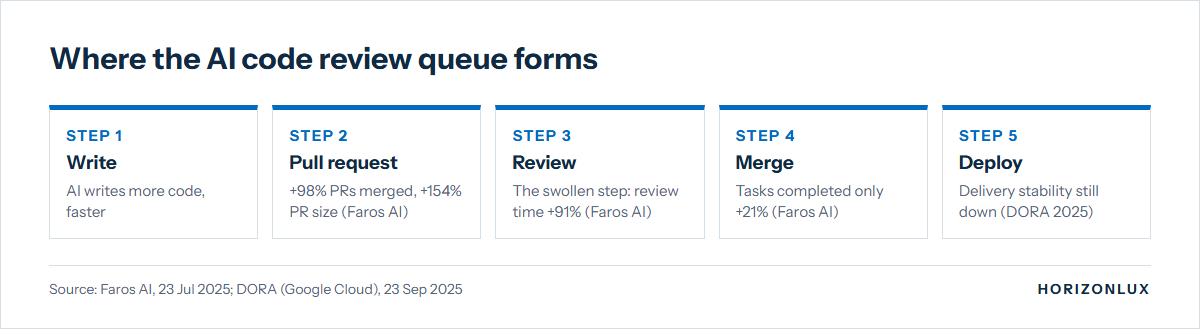 Source: Faros AI, 23 Jul 2025; DORA (Google Cloud), 23 Sep 2025. Chart by HorizonLux.
DORA 2025 adds what happens after the queue. Throughput is now up, but stability is still down, so more of what gets through review causes trouble in production. Rushed reviews on oversized PRs are one likely reason, though DORA does not measure that directly.
Not everyone agrees review is the true constraint. An opinion piece in The New Stack argues that work also piles up after review, in deployment batches, so speeding up review alone could push the pressure downstream. That is a fair warning: measure the whole path from commit to production, not only review.
Why AI review tools only shift the problem
An AI reviewer adds comments. It does not take the approval decision off the human, and the PRs it reviews carry more issues to begin with.
CodeRabbit, which sells AI code review, reported on 17 December 2025 that across 470 open-source pull requests, those co-authored by AI averaged 10.83 issues against 6.45 for human-only PRs. Treat it as vendor research, but the direction matches the Faros bug figure.
So an AI reviewer can catch some of those issues earlier, and that helps. But a person still has to read the change, judge the comments and approve. We found no source that measures a cut in human review time from adding an AI reviewer, so do not plan on one.
How to clear the queue
Change what arrives at review before you add tools to it.
Cap PR size, and ask the agent for small, stacked changes
Large PRs are the input that swells review. Set a size limit your reviewers agree with, and tell the coding agent to split work into small, stacked PRs that each do one thing. An agent will happily write one large change if you let it.
Run tests, lint and security scans before a human sees the PR
A person should never be the first to find a failing test or a missing import. Make CI run tests, linting, type checks and a security scan on every PR, and only request review once they pass.
Make the author, or the agent, write the review packet
Every PR should explain what changed, why, and how it was tested, with the commands or screenshots to prove it. When an agent wrote the code, the agent writes this packet, and the person who ran the agent checks it. Reviewers then spend time on judgement, not on working out what they are looking at.
Give review protected time, and measure review wait
If review is the slowest step, it needs time on the calendar like any other work. Track how long PRs wait for a first review and how long they take to merge. Those numbers tell you more than lines written or PRs opened.
Use an AI reviewer as a first pass, never as the approver
An AI reviewer is useful for catching obvious issues before a person looks. Keep the approval with a human who understands the change, and do not let any agent merge its own work.
This is how we work at HorizonLux. At RepairCheck, our agents write and deploy the code, and people review and guide the rest. That is our own practice, not a research finding, but it is why we treat review as the step to design for.
If your team needs that capacity, our AI staff augmentation puts an engineer inside your code review, not beside it. You can also hire an AI engineer directly, starting from $3,000/month after a paid pilot. To compare that with growing the team, try the AI team cost calculator.
For the hands-on side, Day 45 of our Claude Code Challenge shows how to run code and security reviews inside Claude Code. If the code in question came from an AI app builder, our checklist to fix a vibe coded app covers what to look for first. And to see what each shipped change really costs, read our post on cost per task.
Frequently asked questions
Why does AI-generated code take longer to review?
There is more of it and each change is bigger. Faros AI found PRs 154% larger on high-AI teams, with review time up 91%. CodeRabbit, a review vendor, also found more issues per AI-co-authored PR, so reviewers have more to find in each one.
Do AI code review tools fix the review bottleneck?
Not on their own. They add a first pass of comments, but a person still reads the change and approves it. We found no published measurement of human review time saved by adding an AI reviewer. Fix PR size and pre-review checks first.
What does the DORA report say about AI and delivery?
DORA 2024 linked rising AI adoption with an estimated 1.5% drop in delivery throughput and 7.2% drop in stability. DORA 2025 found throughput now improves with AI adoption, but stability is still worse, and 30% of respondents have little or no trust in AI-generated code.
How big should a pull request be when AI writes the code?
Small enough that a reviewer can read it in one sitting and understand it. No study we found sets a number for AI-written PRs, so agree a limit with your reviewers, and have the agent split larger work into stacked PRs that each do one thing.
Should an AI be allowed to approve pull requests?
No. Use an AI reviewer as a first pass that flags issues, and keep approval with a person who understands the change. An agent should never merge its own work, because nobody would then have checked it.
Sources
- Google Cloud, “Announcing the 2024 DORA report”, 23 Oct 2024, https://cloud.google.com/blog/products/devops-sre/announcing-the-2024-dora-report
- METR, early-2025 AI and experienced open-source developer productivity study, 10 Jul 2025, https://metr.org/blog/2025-07-10-early-2025-ai-experienced-os-dev-study/
- Faros AI, “The AI Productivity Paradox Report 2025”, 23 Jul 2025, https://www.faros.ai/blog/ai-productivity-paradox-report-2025
- Google Cloud, “Announcing the 2025 DORA report”, 23 Sep 2025, https://cloud.google.com/blog/products/ai-machine-learning/announcing-the-2025-dora-report
- GitLab, AI Accountability Report press release, 23 Jun 2026, https://about.gitlab.com/press/releases/2026-06-23-gitlab-research-reveals-organizations-are-generating-ai-code-faster-than-they-can-control-it/
- The New Stack, “AI hasn’t shifted the bottleneck from coding to code review” (opinion), 16 Jul 2026, https://thenewstack.io/ai-code-bottleneck-myth/
- CodeRabbit, AI vs human code generation report, 17 Dec 2025 (vendor research), https://www.coderabbit.ai/blog/state-of-ai-vs-human-code-generation-report
Notes on sources:
- METR’s page was opened on 26 Nov 2026: 16 developers, 246 tasks, 19% slower, 24% expected speed-up all hold. The page now says the results are out of date and links a February 2026 update, which was not read or cited.
- DORA 2025 announcement re-read on 26 Nov 2026: it gives no review-specific figure. The full report PDF was not opened.
- The New Stack page blocked our fetch; its title and 16 Jul 2026 date come from a search listing. Check the date before publishing.
- The Faros AI 2026 “Acceleration Whiplash” report was not read and is not cited.