
AI projects fail mostly for reasons that have nothing to do with the model: an unclear problem, data that is not ready, rising costs, and nobody owning the system after launch. The famous failure figures measure different things, but on the causes they agree.
That is good news. Every one of those causes can be checked before a pilot starts.
TL;DR
- The figures are not the same measurement. “Fail”, “abandoned after proof of concept” and “canceled” mean different things. Quote each with its definition.
- RAND relays estimates that more than 80% of AI projects fail, about twice the rate of IT projects without AI.
- Gartner finds at least half of generative AI projects were abandoned after proof of concept by the end of 2025.
- The causes overlap: the problem definition, the data, the cost of running the system, and the organisation around it.
- A short checklist run before the pilot catches most of them.
The failure numbers, and what each one measures
Before you quote an AI failure rate, check what the study counted. A project “failing”, a pilot “abandoned after proof of concept” and a project “canceled” are different events, measured on different groups.
RAND: “fail”, as relayed estimates. In its August 2024 report on the root causes of AI project failure, RAND writes that “by some estimates, more than 80 percent of AI projects fail”, which it says is twice the rate of IT projects that do not involve AI. RAND relays that figure from earlier estimates. Its own research is interviews with 65 data scientists and engineers, and that is where its list of causes comes from.
Gartner: abandoned after proof of concept. In a January 2026 article by Arun Chandrasekaran, Gartner says that by the end of 2025, “at least 50% of generative AI projects were abandoned after proof of concept.” The page gives no sample size, so read it as Gartner’s finding, not a survey result. In July 2024 Gartner had predicted a smaller share would be abandoned by then. The real number came in higher than its own forecast.
Gartner: canceled agentic projects, a forecast. In a June 2025 press release, Gartner predicts that over 40% of agentic AI projects will be canceled by the end of 2027, “due to escalating costs, unclear business value or inadequate risk controls.” That is a forecast, not a measured rate.
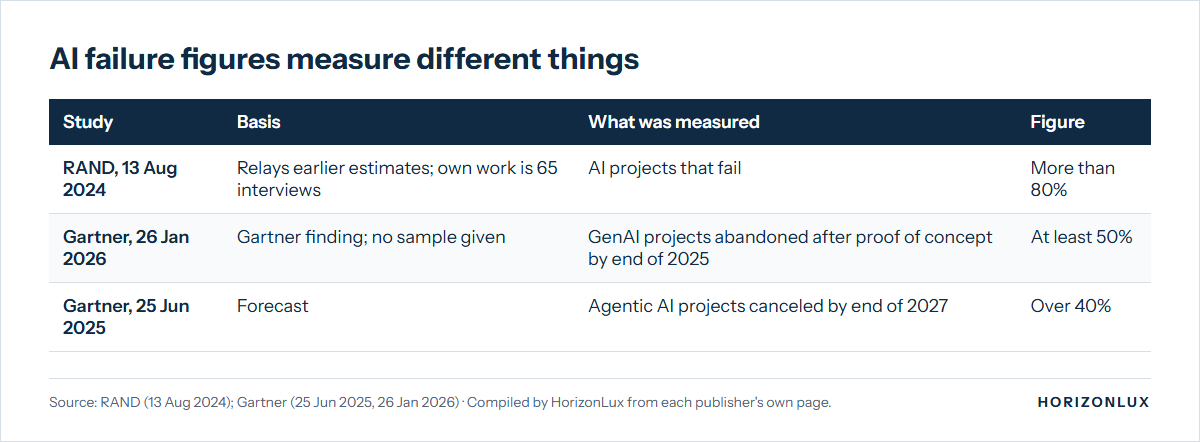 Source: RAND (13 Aug 2024), Gartner (25 Jun 2025 and 26 Jan 2026). Compiled by HorizonLux from each publisher’s own page. Chart by HorizonLux.
Two other figures appear in almost every article on this topic. We left both out, and the reasons are in the sources list at the end. The short version: we could not read them on the publisher’s own page, and one of them is widely misquoted.
The causes the studies agree on
RAND built its list from interviews with practitioners. Gartner published its own list of failure points. The two still overlap heavily.
RAND’s five root causes:
- Leadership misunderstands or miscommunicates the problem, or the metric to optimise.
- The organisation does not have enough data to train an effective model.
- The team focuses on the newest technology rather than on the user’s real problem.
- The infrastructure to manage data and deploy models is not in place.
- The problem is too hard for AI to solve.
Gartner’s five failure points:
- Lack of business value.
- Data isn’t ready.
- Escalating total cost of ownership.
- Responsible AI treated as an afterthought.
- Poor change management.
Put side by side, the same themes come out of both lists: the problem and its value, the data, the cost and infrastructure of running the system, and the people and process around it.
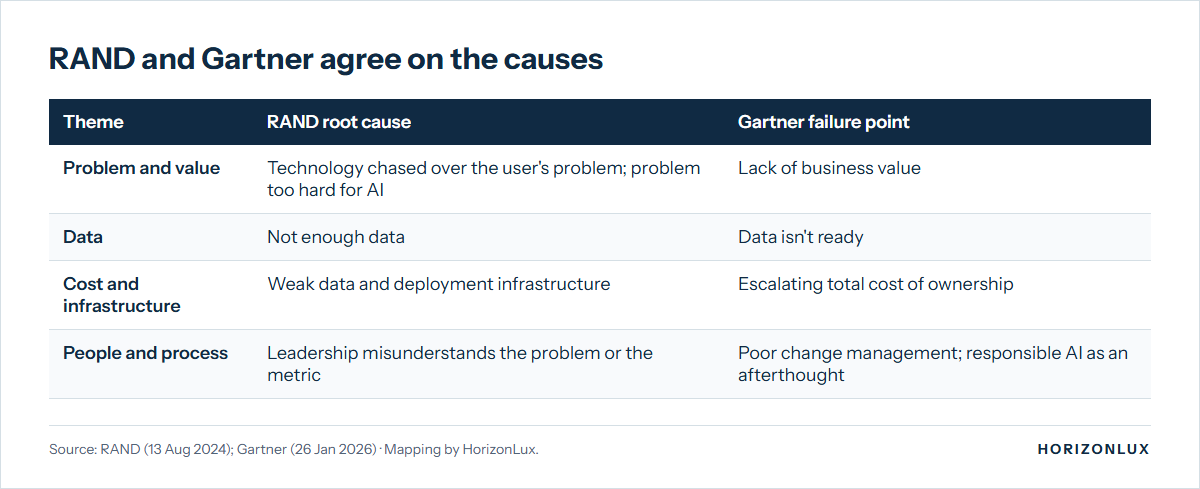 Source: RAND (13 Aug 2024) and Gartner (26 Jan 2026). Mapping by HorizonLux. Chart by HorizonLux.
None of the causes on either list is “the model was not good enough.” Model quality is a constraint, and RAND’s last cause covers problems AI cannot solve. But the projects that die usually die from the work around the model.
What the projects that reach production do differently
The projects that make it change the work around the model, not only the model. Read the two lists backwards and you get what they do.
They start from the business problem. RAND’s first cause is a problem or a metric that leadership did not understand or explain. The fix is a single number the business already cares about, written down before the build: time to resolve a ticket, cost per claim, hours of manual review.
They redesign the workflow. A model bolted onto the old process inherits every bottleneck in it. Gartner’s poor change management point is the same lesson from the other side. If the people doing the work do not change how they work, the pilot has nowhere to land.
They use production data from day one. A cleaned sample makes a good demo and a bad forecast. Both lists name data. The pilot that survives is the one that ran on the messy data it will see in production.
They price the running cost early. Gartner names escalating total cost of ownership. A pilot that looks cheap on a handful of test cases can look very different at full volume. Teams that ship measure cost per task during the pilot, not after.
They name an owner for after launch. Someone has to watch the system, fix it when it drifts, and decide when it is not worth running. Without that person, a working pilot still stalls.
If you are unsure whether to build this in-house, buy a product, or bring in help, our build vs buy AI calculator puts the options side by side.
A pilot-to-production checklist
Each common cause has a check you can run before the pilot starts. Each item below maps back to a row of the comparison above.
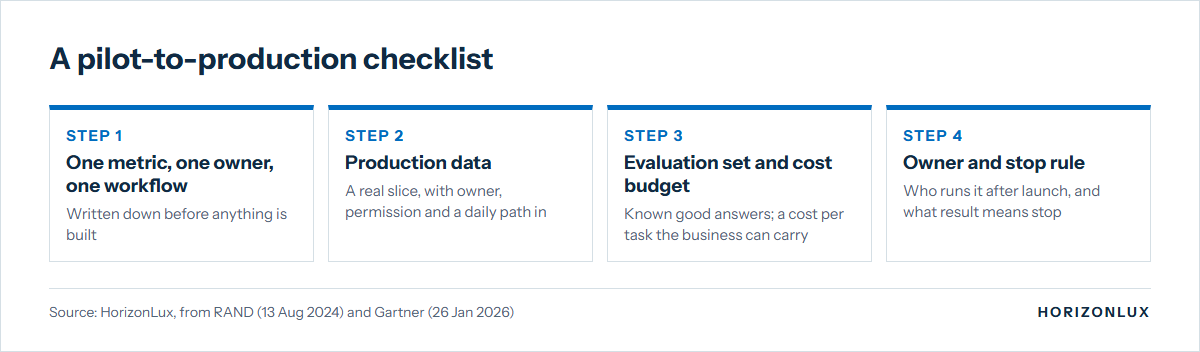 Source: HorizonLux, based on RAND (13 Aug 2024) and Gartner (26 Jan 2026). Chart by HorizonLux.
Before the pilot: one metric, one owner, one workflow
Write down the business metric the pilot should move, the person who owns that metric, and the single workflow you are changing. If you cannot fill in all of them, you are not ready to build. This answers RAND’s first cause and Gartner’s lack of business value.
Our free AI readiness assessment walks you through these questions if you want a structured start.
Data you can actually use in production, not a cleaned sample
Pull a real slice of production data before the pilot starts. Check who owns it, whether you are allowed to use it for this, and how it will reach the system every day, not once. This answers the data cause on both lists.
An evaluation set and a cost-per-task budget
Build a small set of real cases with known good answers, and run every version of the system against it. Set a budget for the cost per task the business can carry at full volume, and measure against it during the pilot. Our guide to AI agent costs breaks down where that money goes. This answers Gartner’s cost of ownership point and RAND’s infrastructure cause.
A named owner after launch, and a stop rule
Name the person who runs the system after launch. Agree in advance what result, by what date, means you stop. A stop rule protects the budget, and it makes the go decision credible too. This answers Gartner’s change management point and RAND’s problems AI cannot solve: if it is not working, you find out early and on purpose.
Where an embedded engineer fits
A paid pilot with one agreed deliverable, that you can stop, is the cheapest way to test this checklist on real work.
That is how we work when you hire an AI engineer from HorizonLux. You start with a paid pilot, priced on its own, with one agreed deliverable. You continue only if it lands. After the pilot, the engagement is from $3,000/month, billed monthly, with notice and a full handover if you stop. The code, IP and docs live in your repo from day one.
Our own delivery works the same way. At RepairCheck, AI handles the full cycle: customer chats, damage analysis, estimates, and the code itself, written and deployed by our agents.
If you need the strategy before the build, our AI strategy consulting work starts with the metric, the owner and the workflow. For a wider view of how far teams have actually got with agents, see our roundup of AI agents in production.
Frequently asked questions
What percentage of AI projects fail?
It depends on the definition. RAND relays estimates that more than 80% of AI projects fail. Gartner found at least half of generative AI projects were abandoned after proof of concept by the end of 2025. They are different measurements.
Is the MIT “95%” figure about pilots or companies?
Coverage mixes the two, and the report sits behind a request form, so we could not check its exact wording at the source. Until you can read the report’s own sentence, do not quote the figure, and treat any article that uses it with care.
Why do AI pilots fail to scale?
The same causes repeat across studies: an unclear business metric, data that is not ready for production, a running cost nobody priced, and nobody owning the system after launch. The model itself is rarely the reason.
How long should an AI pilot run?
We found no reliable benchmark for pilot length. What matters more is the shape: one agreed deliverable, a metric and owner named in advance, and a stop rule. A pilot you can stop is safer than a long one you cannot.
Do agentic AI projects fail more often?
Gartner forecasts that over 40% of agentic AI projects will be canceled by the end of 2027, for cost, value and risk reasons. That is a forecast, not a measured rate, so it does not yet show agentic projects fail more often.
Sources
- RAND, James Ryseff, Brandon De Bruhl and Sydne J. Newberry, “The Root Causes of Failure for Artificial Intelligence Projects and How They Can Succeed”, RR-A2680-1, 13 Aug 2024, https://www.rand.org/pubs/research_reports/RRA2680-1.html
- Gartner, Arun Chandrasekaran, “Why GenAI projects fail”, 26 Jan 2026, https://www.gartner.com/en/articles/genai-project-failure (read on Gartner’s mirror host)
- Gartner, “Gartner Predicts Over 40% of Agentic AI Projects Will Be Canceled by End of 2027”, press release, 25 Jun 2025, https://www.gartner.com/en/newsroom/press-releases/2025-06-25-gartner-predicts-over-40-percent-of-agentic-ai-projects-will-be-canceled-by-end-of-2027 (read on Gartner’s mirror host)
- Gartner, “Gartner Predicts 30% of Generative AI Projects Will Be Abandoned After Proof of Concept By End of 2025”, press release, 29 Jul 2024, https://www.gartner.com/en/newsroom/press-releases/2024-07-29-gartner-predicts-30-percent-of-generative-ai-projects-will-be-abandoned-after-proof-of-concept-by-end-of-2025 (cited in the text without its figure)
Dropped after re-checking at source on 26 Nov 2026:
- S&P Global Market Intelligence, Voice of the Enterprise: AI & Machine Learning (companies abandoning most AI initiatives, 17% to 42%; 46% of proofs of concept scrapped; 1,006 respondents). Both S&P pages returned 403. The figures appear only in secondary coverage, so they are out.
- MIT NANDA, “The GenAI Divide: State of AI in Business 2025” (95% of organisations getting zero return; $30 to 40 billion spend). MIT’s group page has no report, only a request form. Copies exist on third-party hosts only, so the figure and the “learning gap” point are out.
- McKinsey, “The state of AI in 2026” (44% scaling; 38% a year earlier; high performers about 6%; 37% EBIT contribution; 1,719 participants). Five attempts on McKinsey’s page and PDF timed out. Figures from search results only, so they are out.
- Gartner’s July 2024 30% forecast figure: kept as a dated reference without the number, so that no figure repeats in the sibling post on agents in production.