
Published figures for “AI agents in production” range widely because each survey asks a different group a different question. Across the three primary surveys HorizonLux read on 25 Nov 2026, the share of organisations reporting agent activity ranged from 57.3% to 75%, and only one of them, LangChain’s, asked about agents in production.
So before you quote a number, check who was asked and what they were asked. This page gives each figure with its publisher, its date and its sample.
How we picked sources. Every figure here comes from the publisher’s own page, with a date and a stated sample. We left out aggregator pages and figures we could not trace to a primary source. The excluded figures are listed at the end.
TL;DR
- Practitioners report a majority in production. 57.3% of LangChain’s respondents had agents in production.
- Executives report a majority building or deploying. KPMG says 62% of large US organisations are building, deploying or developing agents.
- Production agents are short and supervised. In an academic study, 68% of production agents run at most 10 steps before a person steps in.
- Quality is the top barrier, named by 32% of LangChain’s respondents.
- Controls lag adoption. Only 13% of IT application leaders in a Gartner survey strongly agreed they had adequate oversight structures.
How many organisations have agents in production
Practitioner surveys report a majority with agents in production. Executive surveys report a majority building or deploying them. Neither means most work runs on agents.
LangChain: in production. In LangChain’s State of Agent Engineering report, published on 12 June 2026, 57.3% of respondents said they have agents in production, up from 51% the year before. At organisations with 10,000 or more employees, the share was 67%. The survey drew 1,340 responses between 18 November and 2 December 2025. Respondents chose to take part, and most are practitioners, so read it as a view from people already building agents.
KPMG: building, deploying or developing. KPMG’s AI Pulse for Q3 2026, released on 24 September 2026, found that 62% of organisations are building, deploying or developing agents, up from 53% the quarter before. KPMG also found 25% are developing or implementing multi-agent systems. The sample is 314 US C-suite and business leaders at companies with $1 billion or more in revenue, surveyed from 24 July to 25 August 2026. This is a US figure for large companies.
Gartner: piloting or deployed. In a Gartner survey released on 30 September 2025, 75% of IT application leaders said they were piloting, deploying or had deployed some form of AI agent. Only 15% were considering, piloting or deploying fully autonomous agents. Gartner surveyed 360 leaders at organisations with 250 or more employees in North America, Europe and Asia/Pacific, in May and June 2025.
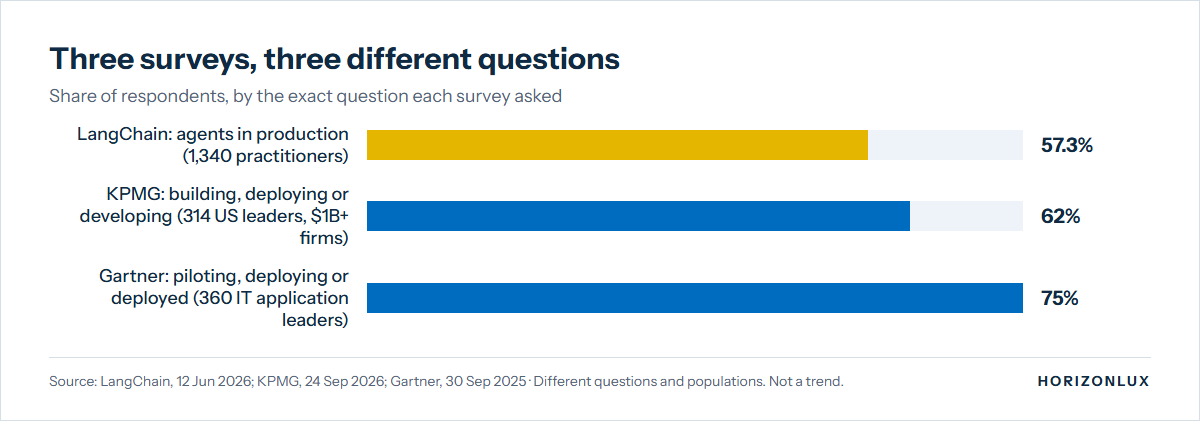 Source: LangChain (12 Jun 2026), KPMG (24 Sep 2026), Gartner (30 Sep 2025). Compiled by HorizonLux from each publisher’s page, 25 Nov 2026. Chart by HorizonLux.
Do not read these three bars as a trend. They are different questions, asked of different people, at different times.
What production agents actually look like
Production agents are short, supervised and built on off-the-shelf models. The best evidence comes from an academic study of deployed systems, not a market survey.
They run few steps before a person steps in. In Measuring Agents in Production by Pan and colleagues (arXiv 2512.04123, version 4, 4 June 2026), 68% of production agents execute at most 10 steps before human intervention.
They are prompted, not fine-tuned. The same study found 70% rely on prompting off-the-shelf models rather than tuning model weights.
People judge their output. 74% depend primarily on human evaluation, the study found.
The study combined 20 case-study interviews with a survey of 86 practitioners working on deployed systems, across 26 domains. It is small, but it looks at systems already running, which most surveys do not.
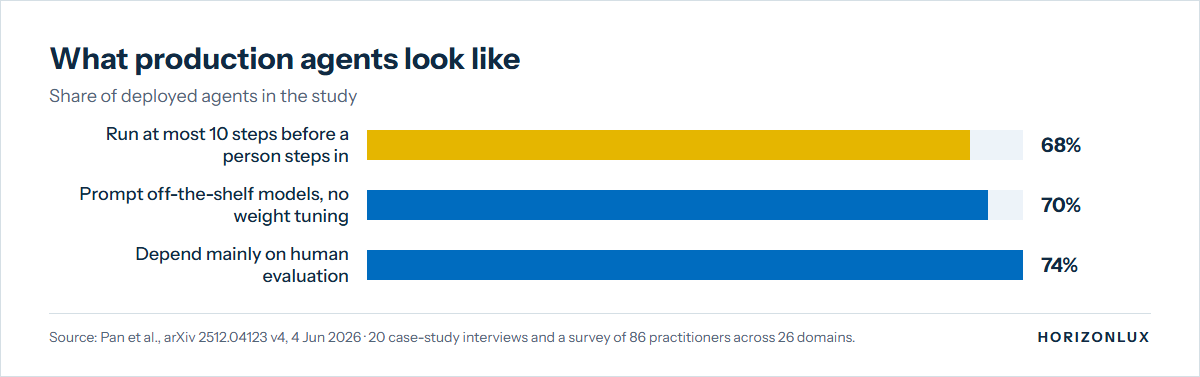 Source: Pan et al., “Measuring Agents in Production”, arXiv 2512.04123 v4, 4 Jun 2026. Chart by HorizonLux.
What they are used for. In LangChain’s survey, customer service was the most common use case, at 26.5% of respondents, followed by research and data analysis at 24.4%.
If you are planning an agent for one of those jobs, our AI agent development page shows how we scope one. Short, supervised agents are also the cheapest kind to run; our guide to AI agent costs explains why.
Quality, observability and controls
Quality, not cost, is the barrier respondents name most often, and controls lag behind adoption.
Quality comes first. LangChain’s respondents named quality as the biggest barrier to production, at 32%.
Most teams can see what their agents do. 89% of LangChain’s respondents have some form of agent observability, and 62% have detailed tracing.
Fewer test them properly. 52.4% run offline evaluations, and 37.3% run online evaluations, according to LangChain.
Executives are drawing lines. KPMG found 49% of organisations have defined high-risk use cases where agents cannot make decisions on their own.
Trust and oversight are thin. In Gartner’s 2025 survey, only 19% of IT application leaders had high or complete trust in their vendors’ protection against hallucinations. Only 13% strongly agreed they had adequate oversight structures, and 74% saw agents as a new attack vector.
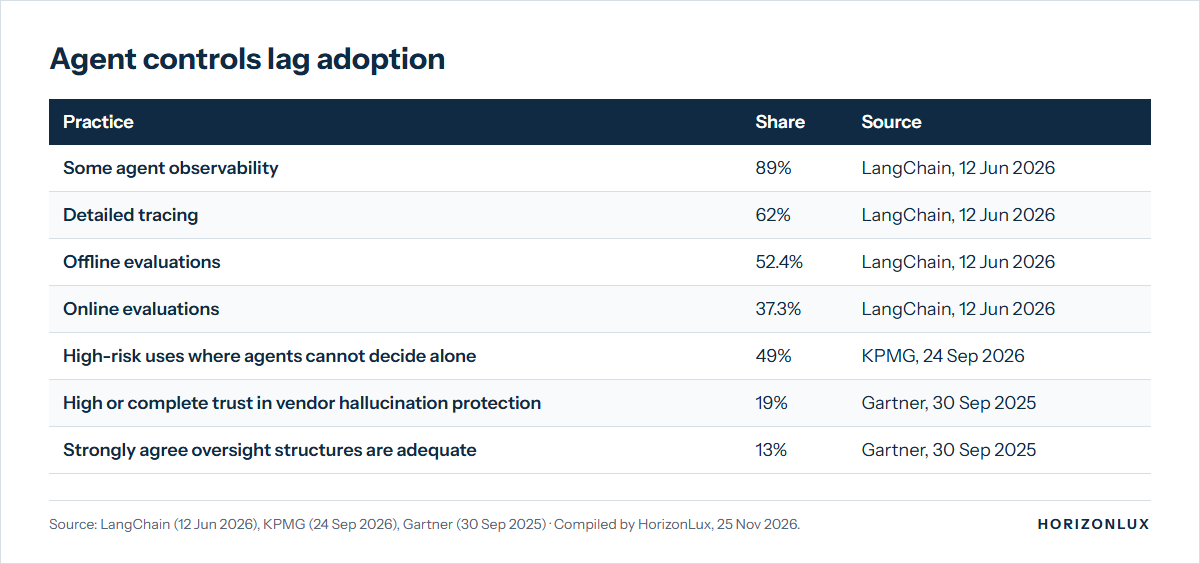 Source: LangChain (12 Jun 2026), KPMG (24 Sep 2026), Gartner (30 Sep 2025). Compiled by HorizonLux, 25 Nov 2026. Chart by HorizonLux.
The gap between observability and evaluation matters. Tracing shows you what an agent did. Evaluation tells you whether it was right. A team with tracing and no evaluation set finds out about quality problems from its users.
Identity and access are part of the control gap too. If your agents call tools over MCP, our post on MCP OAuth security covers how to scope what they can reach.
Spending and forecasts
Forecasts are large. Keep them separate from measured adoption, because a forecast is a prediction, not a count.
Spending. Gartner forecasts AI agent software spending of $206.5 billion in 2026, in a press release of 5 May 2026.
Cancellations. Gartner has also forecast that a large share of agentic AI projects will be canceled, for cost, value and risk reasons. We cover that forecast, and the measured failure rates beside it, in our post on why AI projects fail.
If you want to see what an agent would cost you before committing budget, the free agent cost estimator gives a per-task figure from your own volumes.
How to read agent statistics
Before you quote any agent number, check four things.
- Who was asked. Practitioners who opted in to a developer survey answer differently from C-suite leaders at billion-dollar firms. Neither is “all companies”.
- What “production” meant. “In production”, “building, deploying or developing”, “piloting or deployed” and “scaling” are four different questions. A figure without its question is not a figure.
- When it was fielded. Agent adoption moves quarter to quarter. A survey fielded in mid-2025 describes a different market from one fielded in late 2026.
- Who published it. A vendor’s own survey of its own users is still data, but say so. An aggregator page that gives no primary link is not a source.
The same four checks apply to anything you read about agents, including this page.
How to cite this page. “AI agents in production: 2026 statistics, with every source”, HorizonLux, 26 November 2026, https://horizonlux.com/blog/ai-agents-in-production-statistics. Please cite the original survey for each figure as well.
If you need agents built and run inside your own stack, you can hire an AI engineer who works in your repo. For how agents talk to each other in multi-agent setups, see MCP vs A2A.
Frequently asked questions
What percentage of companies use AI agents in production?
It depends on the survey. 57.3% of LangChain’s practitioner respondents had agents in production (fielded November to December 2025). KPMG says 62% of large US firms are building, deploying or developing agents (Q3 2026). They ask different questions of different people.
Are most AI agents fully autonomous?
No. Gartner found only 15% of IT application leaders were considering, piloting or deploying fully autonomous agents in 2025. In the arXiv study of deployed systems, 68% of production agents run at most 10 steps before a person steps in.
What is the biggest barrier to putting agents in production?
Quality. LangChain’s respondents named it as the biggest barrier, at 32%. That fits the evaluation gap: most teams trace their agents, but fewer run evaluations that tell them whether the output is right.
How much will companies spend on AI agents in 2026?
Gartner forecasts $206.5 billion in AI agent software spending in 2026. That is a forecast from May 2026, not a measured total, so treat it as a sense of scale.
Why do agent statistics disagree so much?
They measure different things. The surveys ask different populations (practitioners or executives), different questions (in production, building, piloting or scaling), at different dates. Compare figures only when all three match.
Sources
- LangChain, “State of Agent Engineering”, published 12 Jun 2026 (1,340 responses, 18 Nov to 2 Dec 2025), https://langchain.com/state-of-agent-engineering
- KPMG, “AI Pulse Q3 2026”, released 24 Sep 2026 (314 US leaders at $1B+ firms, 24 Jul to 25 Aug 2026), https://kpmg.com/us/en/media/news/q3-ai-pulse-2026.html
- Gartner, “Gartner Survey Finds Just 15% of IT Application Leaders Are Considering, Piloting, or Deploying Fully Autonomous AI Agents”, press release, 30 Sep 2025, https://www.gartner.com/en/newsroom/press-releases/2025-09-30-gartner-survey-finds-just-15-percent-of-it-application-leaders-are-considering-piloting-or-deploying-fully-autonomous-ai-agents (read on Gartner’s mirror host)
- Pan et al., “Measuring Agents in Production”, arXiv 2512.04123, v4, 4 Jun 2026, https://arxiv.org/abs/2512.04123
- Gartner, press release on autonomous business and AI agent software spending, 5 May 2026, https://www.gartner.com/en/newsroom/press-releases/2026-05-05-gartner-says-autonomous-business-and-artificial-intelligence-layoffs-may-create-budget-room-but-do-not-deliver-returns (read on Gartner’s mirror host)
Dropped after re-checking at source on 26 Nov 2026:
- McKinsey, “The state of AI in 2026”: the rise in the share of $1B+ organisations scaling agents in at least one function, and the flat 22% for smaller organisations. Repeated attempts on McKinsey’s page and PDF timed out; the figures come from search results only.
Left out so that no figure repeats in the sibling post on why AI projects fail (all confirmed on 25 Nov, just not used here):
- Gartner’s forecast for enterprise applications with task-specific agents by the end of 2026 (26 Aug 2025).
- Gartner’s agentic cancellation forecast (25 Jun 2025): linked to the sibling post instead.
- Gartner’s workforce-reduction figure in the 5 May 2026 release.
- KPMG’s share of organisations building controls into agents, and its earlier-quarter comparisons for multi-agent systems.
Excluded, no primary source found: a Gartner deployment figure relayed by a vendor blog citing a paid Hype Cycle; Deloitte “11% in production”; Zapier “71%” (vendor’s own survey, not read); “88% of pilots fail” attributed to Forrester and Anaconda by an aggregator.