
There is no single winner, so pick by job. Claude Fable 5.2 and GPT-6.2 Astra have the same list price, $8 per million input tokens and $40 per million output tokens, and each leads on different tests its own lab chose.
For high-volume work, the cheaper tiers matter more than the flagships. GPT-6.2 Sol costs $2 / $10 per million tokens, and Gemini 4 Neon and Hydrogen sit at $3 / $15 and $1.50 / $7.50. Gemini 4 Carbon costs $2 / $10 until 30 November 2026 and $4 / $20 from 1 December 2026.
The three releases, in one table
All three labs shipped inside ten days, between 9 and 18 November 2026. Every model below has about a million tokens of context, and the two flagships are priced level.
List prices per million tokens, read by HorizonLux from provider pages on 25 Nov 2026.
| Model | Released | Context (tokens) | Max output | Input / output, $ per 1M | Cached input, $ per 1M |
|---|---|---|---|---|---|
| Claude Fable 5.2 | 9 Nov 2026 | 1,000,000 | 128,000 | 8 / 40 | 0.20 |
| GPT-6.2 Astra | 17 Nov 2026 | 1,050,000 | 128,000 | 8 / 40 up to 272K input; 16 / 60 above | 0.40 |
| GPT-6.2 Sol | 17 Nov 2026 | 1,050,000 | 128,000 | 2 / 10 up to 272K input; 4 / 15 above | 0.10 |
| Gemini 4 Carbon | 10 Nov 2026 | 1,048,576 | 65,536 | 2 / 10 until 30 Nov 2026; 4 / 20 from 1 Dec 2026 | 0.10 now; 0.20 from 1 Dec |
| Gemini 4 Neon | 18 Nov 2026 | 1,048,576 | 65,536 | 3 / 15 | 0.15 |
| Gemini 4 Hydrogen | 12 Nov 2026 | 1,048,576 | 65,536 | 1.50 / 7.50 (free tier exists) | 0.075 |
All six offer a 50% discount on batch requests, per the same provider pages. Anthropic’s figures come from its pricing page and Fable 5.2 model page. OpenAI’s come from its pricing page and GPT-6.2 Astra model page. Google’s come from the AI Studio pricing page and Gemini 4 Carbon model page.
Our AI model directory keeps these rows current, with the source and check date on each one.
Which model each name means
- GPT-6.2 comes in two tiers: Astra, the flagship, and Sol, the efficient model for everyday work and agents at scale.
- Gemini 4 has three: Carbon for the hardest reasoning, Neon for frontier-level work at faster speed, and Hydrogen for fast everyday tasks. Hydrogen is the only one on the free tier.
- Claude Fable 5.2 has a twin, Claude Mythos 5.2. It is the same model, offered only to verified organizations, at the same price.
What one business job costs on each
On a typical short call, the flagships cost about four times as much as the efficient tiers. That makes the tier you choose matter more than the provider you choose.
HorizonLux calculated the cost of one call with 10,000 input tokens and 1,000 output tokens, with no caching, from the list prices in the table above. Claude Fable 5.2 and GPT-6.2 Astra each cost $0.12 per call, or $120 per 1,000 calls.
At the same volume, GPT-6.2 Sol costs $30 per 1,000 calls, Gemini 4 Neon $45 and Gemini 4 Hydrogen $22.50. Gemini 4 Carbon costs $30 per 1,000 calls at its price until 30 November 2026, and $60 at its price from 1 December 2026.
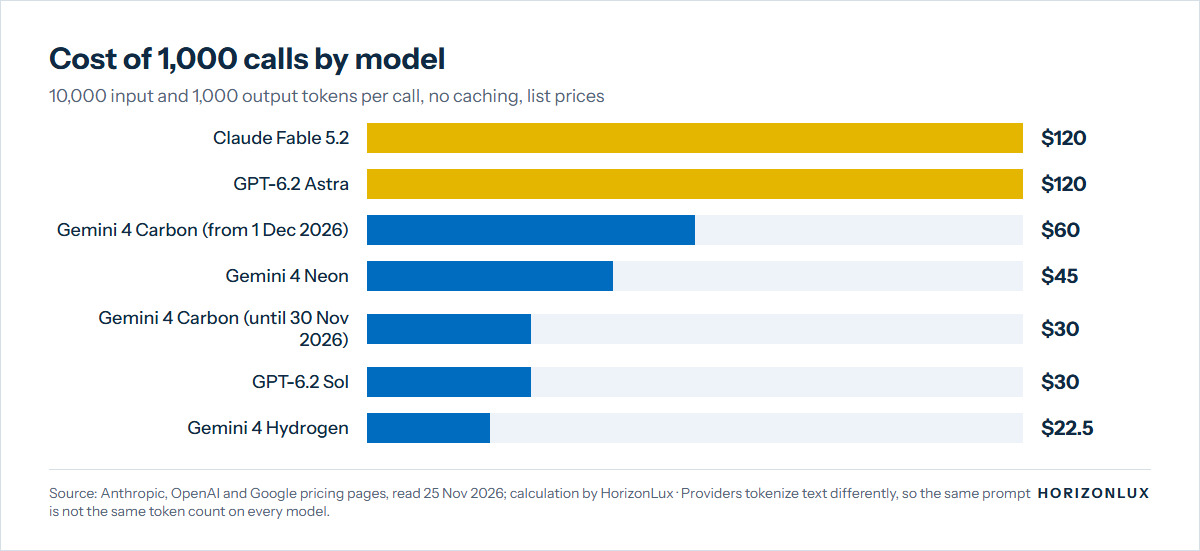 Source: Anthropic, OpenAI and Google pricing pages, read 25 Nov 2026. Chart by HorizonLux.
One caveat matters here. Each provider splits text into tokens its own way, so the same prompt is not the same token count on every model. The fair comparison is cost per finished task, which you can only get by running your own work through each one. To try other token counts, use the LLM pricing calculator.
What each lab says its model is best at
Each lab’s own table shows its model ahead on the tests it chose. Read them as claims, not as a neutral ranking. No lab published a table that compares all three November models against each other.
| Model | Test | Score | Reported by | Compared against |
|---|---|---|---|---|
| Claude Fable 5.2 | AutomationBench (business workflows) | 51.4% | Anthropic | GPT-6 Astra, Gemini 4 Carbon |
| Claude Fable 5.2 | AA-Briefcase v1.1 (knowledge work rubric) | 66.1% | Anthropic | GPT-6 Astra, Gemini 4 Carbon |
| Claude Fable 5.2 | Remote Labor Index | 41.3% | Anthropic | GPT-6 Astra |
| Claude Fable 5.2 | FrontierSWE v2 | 69.9% | Anthropic | GPT-6 Astra, Gemini 4 Carbon |
| Gemini 4 Carbon | AutomationBench | 53.9% | GPT-6 Astra, Claude Fable 5.1 | |
| Gemini 4 Carbon | GraphWalks, 256K to 1M tokens | 96.2% | GPT-6 Astra, Claude Fable 5.1 | |
| Gemini 4 Neon | AutomationBench | 56.3% | GPT-6.2 Sol | |
| Gemini 4 Neon | Agents’ Last Exam v1.1 | 75.8% | GPT-6.2 Sol |
Anthropic’s launch post for Fable 5.2, published 9 November 2026, compares it with GPT-6 Astra, not GPT-6.2. In that same table, Gemini 4 Carbon scores 53.9% on AutomationBench, ahead of Fable 5.2’s 51.4%.
Google’s Gemini 4 Carbon model card, published 10 November 2026 with results as of October 2026, also reports a Vending-Bench 2 bank balance of $16,484. Its comparison columns include GPT-6 Astra and Claude Fable 5.1, not the November releases.
Google’s Gemini 4 Neon model card, published 18 November 2026, is the only page that scores a GPT-6.2 model. It puts GPT-6.2 Sol at 41.3% on AutomationBench and 73.0% on Agents’ Last Exam v1.1.
OpenAI’s GPT-6.2 launch post gives gaps, not scores, in its text. It says Astra scored “5.5 points ahead of Claude Fable 5.2” on Agents’ Last Exam and more than doubled Fable 5.2’s pass rate on Harvey’s LAB-AA legal test.
AutomationBench is the one test three labs report a score for. OpenAI shows its AutomationBench result only in a chart, with no number in the text, so GPT-6.2 Astra is missing below.
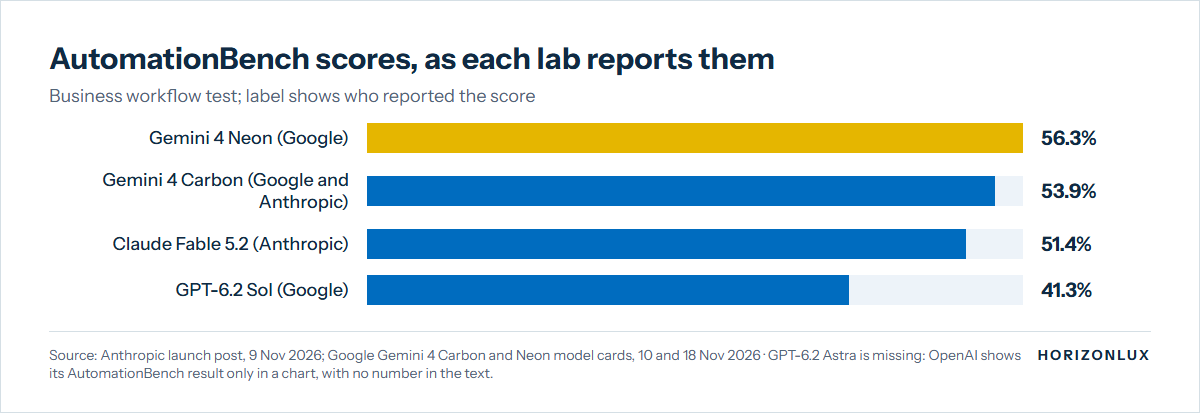 Source: Anthropic launch post, 9 Nov 2026; Google model cards, 10 and 18 Nov 2026. Chart by HorizonLux.
Which one for which job
Customer-facing chat and support at volume
Start with GPT-6.2 Sol, Gemini 4 Hydrogen or Gemini 4 Neon. At these volumes the price gap compounds, and a support reply rarely needs the top model. Send only escalations, such as refunds or complaints, to a flagship.
Back-office agents that run multi-step workflows
Gemini 4 Neon and Carbon lead the AutomationBench scores above, and Fable 5.2 is close behind. These are each lab’s own numbers on a test of business workflows. Shortlist two and test them on your real tasks before you commit.
Legal, finance and document-heavy work
OpenAI reports the Harvey legal result for Astra. Anthropic’s launch post quotes customers including Harvey, Box and several trading and investment firms on document review and research work. Both are vendor claims, so treat them as a reason to test, not as proof.
Long documents
All three advertise about a million tokens of context. GPT-6.2 prices rise past 272K input tokens: Astra goes from $8 / $40 to $16 / $60, per OpenAI’s pricing page. A big window is also not the same as good recall, which our context window comparison and post on context rot cover.
Coding agents
The model is only half the choice for coding. The tool around it matters just as much, so we compare those separately in Claude Code vs Cursor vs Codex.
How to choose without trusting any of these tables
Run 20 to 50 of your own tasks through two candidates, then compare the cost per finished task, not the price per token. A cheaper model that needs two retries can cost more than a dearer one that gets it right first time.
- Pick real tasks from the last month: tickets, documents, workflow runs.
- Write down what a correct answer looks like for each one before you test.
- Run each task on two shortlisted models with the same prompt.
- Count the finished tasks, the retries and the tokens used.
- Divide the total cost by the finished tasks.
- Add prompt caching and batch requests where they fit, then run the numbers again.
You can compare these models side by side before you start, and our guide to LLM cost optimization covers the levers after you pick.
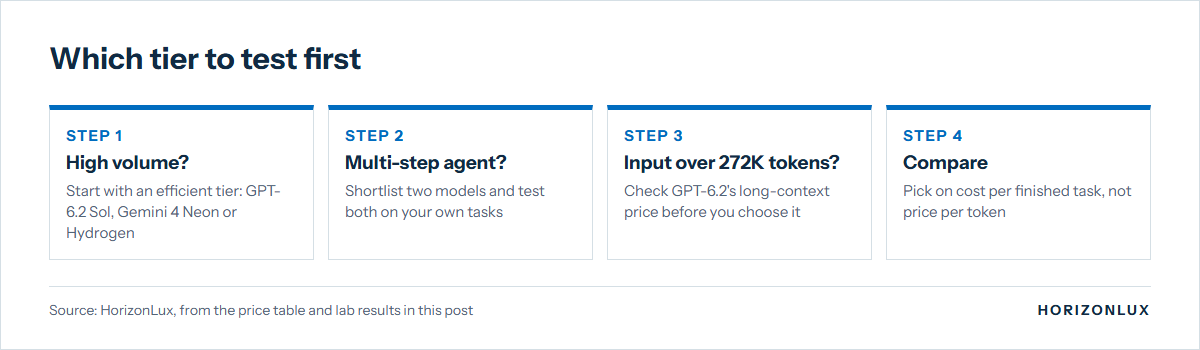 Source: HorizonLux, from the price table and lab results in this post, 26 Nov 2026. Chart by HorizonLux.
If you want someone to run this test inside your stack, you can hire an AI engineer from HorizonLux, from $3,000/month, starting with a paid pilot.
Frequently asked questions
Is GPT-6.2 cheaper than Claude Fable 5.2?
The flagships have the same list price: $8 input and $40 output per million tokens for both GPT-6.2 Astra and Claude Fable 5.2, per the provider pages on 25 November 2026. Astra costs more above 272K input tokens. GPT-6.2 Sol, the cheaper tier, is $2 / $10.
Which is the best AI model for business in November 2026?
No neutral source ranks all three. Each lab leads its own table, and no lab table compares all three November models. Pick by job, shortlist two, and test them on your own tasks.
Does Gemini 4 have a free tier?
Only Gemini 4 Hydrogen, per Google’s AI Studio pricing page on 25 November 2026. Google says free-tier data is used to improve its products, so keep customer data on the paid tier.
What context window do GPT-6.2, Fable 5.2 and Gemini 4 have?
GPT-6.2 Astra and Sol take 1,050,000 tokens, Claude Fable 5.2 takes 1,000,000, and every Gemini 4 model takes 1,048,576, per the provider model pages on 25 November 2026.
What is Claude Mythos 5.2?
It is the same underlying model as Claude Fable 5.2, offered only to organizations Anthropic has verified, at the same price of $8 / $40 per million tokens.
When does the Gemini 4 Carbon price change?
Carbon costs $2 input and $10 output per million tokens until 30 November 2026. From 1 December 2026 it costs $4 / $20, with cached input rising from $0.10 to $0.20, per Google’s pricing page.
Sources
- HorizonLux,
models.json(AI model directory data), rows for Claude Fable 5.2, Claude Mythos 5.2, GPT-6.2 Astra, GPT-6.2 Sol, Gemini 4 Carbon, Gemini 4 Neon and Gemini 4 Hydrogen, checked 25 Nov 2026. - Anthropic, “Pricing”, read 25 Nov 2026, https://platform.claude.com/docs/en/about-claude/pricing
- Anthropic, “Claude Fable 5.2” model overview, read 25 Nov 2026, https://platform.claude.com/docs/en/models/fable-5-2/overview
- Anthropic, “Claude Mythos 5.2” model overview, read 25 Nov 2026, https://platform.claude.com/docs/en/models/mythos-5-2/overview
- Anthropic, “Claude Fable 5.2 and Mythos 5.2” launch post, 9 Nov 2026 (edited 11 Nov), re-read 26 Nov 2026, https://www.anthropic.com/claude-fable-and-mythos-5-2
- OpenAI, “Pricing”, read 25 Nov 2026, https://developers.openai.com/api/docs/pricing
- OpenAI, “GPT-6.2 Astra” model page, read 25 Nov 2026, https://developers.openai.com/api/docs/models/gpt-6.2-astra
- OpenAI, “Introducing GPT-6.2 Astra and Sol”, no date on page, re-read 26 Nov 2026, https://openai.com/index/introducing-gpt-6-2-astra-sol/
- Google, “Gemini API pricing” (AI Studio), read 25 Nov 2026, https://aistudio.google.com/docs/pricing
- Google, “Gemini 4 Carbon” model page, read 25 Nov 2026, https://aistudio.google.com/docs/models/gemini-4-carbon
- Google DeepMind, “Gemini 4 Carbon model card”, 10 Nov 2026, re-read 26 Nov 2026, https://deepmind.google/models/model-cards/gemini-4-carbon/
- Google DeepMind, “Gemini 4 Neon model card”, 18 Nov 2026, re-read 26 Nov 2026, https://deepmind.google/models/model-cards/gemini-4-neon/
Gaps: GPT-6.2 Astra’s absolute benchmark scores appear only in charts on OpenAI’s page, so they are left out. Gemini 4 Hydrogen has no benchmarks in our data. Third-party index figures were not read at the source and are not used. Google publishes no knowledge cutoff for Gemini 4.